A field can store a large supply of energy
Picture a magnet pulling on another magnet across a gap. The force acts before the magnets touch. A magnetic field also has energy distributed through the space it occupies. Change the arrangement of the magnets, and the field can do mechanical work.
The Sun contains plasma, a gas with mobile electrons and ions. Its moving gas can bend and rearrange magnetic fields. A stressed field can have more energy than a smoother configuration with the same imposed boundaries. The excess is a possible source of motion and heating when the field relaxes.
Field strength matters strongly. At a fixed volume, doubling the magnetic field gives four times its magnetic energy. A large volume can store substantial energy even when each small part seems unremarkable. The next question is how that energy finds a route out.
A thin current layer lets the arrangement change
Imagine two neighbouring regions whose magnetic fields point in different directions. The change of direction can become concentrated in a narrow layer carrying electric current. This is a current sheet. It is a physical region of the plasma, not an extra object inserted between two field lines.
Away from a small nonideal region, a smooth conducting fluid approximately carries magnetic flux with it. Inside that region, the field and fluid can slip relative to one another. Magnetic reconnection names the resulting change of magnetic connection. The field outside can then relax and push plasma into outflows.
Drawn field lines help us follow the geometry. They are curves tangent to the local field direction, not material ropes. The useful physical questions concern the field, electric current, fluid velocity and energy. Those quantities can be measured or calculated even when a drawing makes the rearrangement look like two lines snapping.
Sources: Zhou et al. (2019), Magnetic island merger as a mechanism for inverse magnetic energy transfer, Physical Review Research 1, 012004(R) · Burch et al. (2016), Electron-scale measurements of magnetic reconnection in space, Science 352, aaf2939, Figures 3–5
Follow the motion before looking at the light
A relaxing field accelerates plasma. Electric resistance converts some energy associated with current into heat; viscosity can convert fluid motion into heat as well. In a simple fluid calculation, magnetic energy can fall while kinetic energy and dissipative heat rise. Their changes show where the stored energy has gone.
In an actual flare, the plasma also conducts heat, emits radiation and contains particle distributions that need not resemble a single-temperature gas. These processes determine how a magnetic-energy release appears in a particular wavelength band. A burst of X-rays is therefore a view of part of the conversion, shaped by the emitting gas and the instrument.
The two GOES X-ray bands on 10 May 2024 rise and fall differently. Each detector reports irradiance, the radiation arriving per area and per second in its own band. The curves provide an observable event to analyze. A later chapter works from the exact original NOAA file and shows how to handle its one-minute samples.
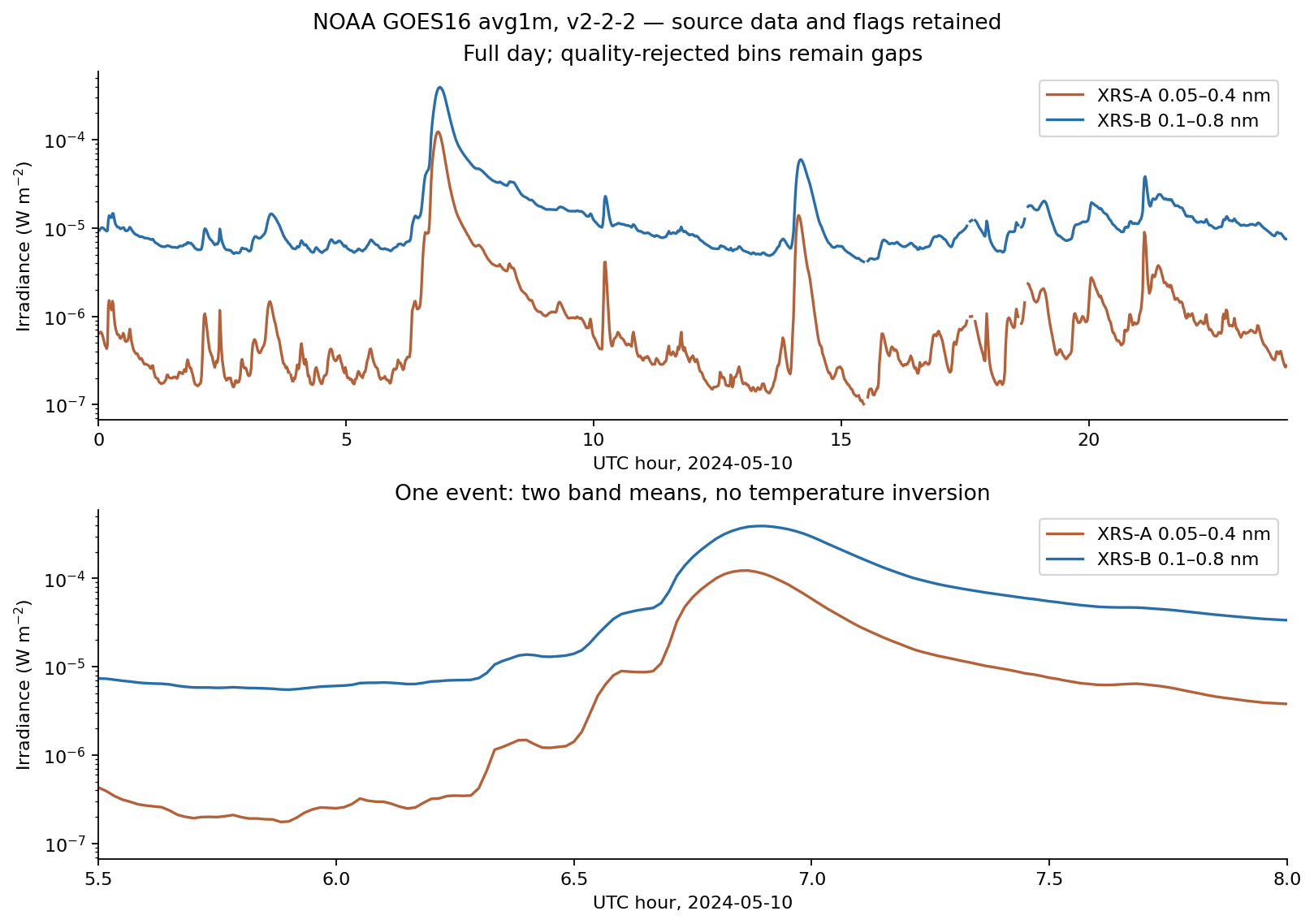
Sources: NOAA NCEI, GOES16 XRS science-quality one-minute means, 2024-05-10, v2-2-2 · NOAA, GOES-R XRS L2 Data Users Guide, §§2.1–2.4 and quality-flag tables
The small scales carry a large part of the question
The narrow region matters because it allows a much larger surrounding field to change. Making a numerical picture smoother does not establish that the thin region was resolved. A calculation must also recover the local induction equation and agree with a finer grid.
Spacecraft can examine a different setting directly. In the 2015 MMS magnetopause encounter, instruments measured fields and electron distributions as the spacecraft crossed an electron-scale reconnection region near Earth. The 2016 paper connects those measurements in time. This is complementary evidence about reconnection physics, with a different location and different observables from a solar X-ray curve.
The central picture is now concrete: a magnetic field stores energy, a nonideal region permits a change of connection, and the surrounding field drives motion and other forms of energy. The scale of the stored field and the physics inside the thin region both shape the release.
Sources: Burch et al. (2016), Electron-scale measurements of magnetic reconnection in space, Science 352, aaf2939, Figures 3–5 · Zhou et al. (2019), Magnetic island merger as a mechanism for inverse magnetic energy transfer, Physical Review Research 1, 012004(R)