Verify the named source before parsing it
Use the GOES16 science-quality XRS one-minute product for 2024-05-10, version 2-2-2. NOAA released this reprocessed version in October 2026. The package includes the exact original 301570-byte NetCDF4/HDF5 file with its original metadata.
The reader checks both length and the full SHA-256 before opening values. The fixed filename is part of the data identity. A similarly named operational or earlier-version file can have different calibration or processing, even if the event looks familiar.
The helper’s default plan and verification modes use no network. Explicit reacquisition requests only this named URL and rejects changed or oversized input. The selected original file permits unrestricted reuse and redistribution; the package retains the NOAA NCEI Solar Irradiance Team attribution.
python scripts/astronomy/ac28/reacquire_goes.py --plan
python scripts/astronomy/ac28/reacquire_goes.py --verify docs/astronomy/ac28/research/sci_xrsf-l2-avg1m_g16_d20240510_v2-2-2.nc| Input identity | Fixed value |
|---|---|
| Bytes | 301570 |
| SHA-256 | 93146eb0a920a8c0cfe5f74897c90978e17006f8280dcc73a5f99aeafec8ba16 |
| Product | sci_xrsf-l2-avg1m_g16_d20240510_v2-2-2.nc |
Sources: NOAA NCEI, GOES16 XRS science-quality one-minute means, 2024-05-10, v2-2-2 · NOAA, GOES-R XRS L2 Data ReadMe, release v2-2-2, 6 October 2026 · NOAA NCEI Open Data Policy, signed 2023, §4a; selected file’s unrestricted-reuse statement
Read the bandpasses and the actual clock
The short channel XRS-A covers ; XRS-B covers . Both flux columns contain band irradiance in . They are instrument-band signals at the observer.
The file contains 1440 record-start minute means. Its time coordinate is seconds since 2000-01-01 at 12:00:00 UTC, with leap seconds neglected. This is not the TT epoch called J2000. The script compares two independent calendar conversions and preserves the source convention.
A peak at 06:54 labels the minute beginning at 06:54. It is not an individually timed photon event or a subminute maximum. Keep that interpretation when comparing the two bands or a separate event catalogue.
Sources: NOAA, GOES-R XRS L2 Data Users Guide, §§2.1–2.4 and quality-flag tables · NOAA NCEI, GOES16 XRS science-quality one-minute means, 2024-05-10, v2-2-2
Select valid bins and count the contributing seconds
Read the primary flag, the number of contributing one-second points and the electron-correction flag. This analysis requires primary flag zero, between 54 and 60 valid points, finite flux above the source floor, and valid non-interpolated, non-decaying electron correction with no significant correction in the primary band. The count fill value 255 is rejected.
The 54-point threshold is an analysis choice requiring at least 90% of the nominal minute. It does not manufacture missing seconds. Interpolated primary bins remain gaps even when a plotted line could connect them smoothly.
In 06:00–08:00 UTC, 120 of 120 bins pass in each band. However, XRS-A has four partially sampled bins with 7195 of 7200 possible seconds, including a minimum of 58 in one bin. XRS-B has all 7200 contributing seconds. Good-bin coverage and complete exposure are different quantities.
| Selected event | XRS-A | XRS-B |
|---|---|---|
| Accepted minute bins | 120 | 120 |
| Contributing seconds | 7195 | 7200 |
| Partly sampled bins | 4 | 0 |
| Minimum seconds in a bin | 58 | 60 |
Sources: NOAA, GOES-R XRS L2 Data Users Guide, §§2.1–2.4 and quality-flag tables · NOAA NCEI, GOES16 XRS science-quality one-minute means, 2024-05-10, v2-2-2
Recompute the two peaks
Run the analysis command below. It writes a compact result JSON and source-metadata report. Plotting is a separate optional command, so checking the numeric result does not require a plotting installation.
The A-band peak minute begins at 06:52 UTC with mean . The B-band peak begins at 06:54 with mean . Dividing the latter by the nominal X-level threshold gives about 3.93.
Call this an X3.93-like one-minute science-product level. It does not claim to reproduce an operational flare catalogue, whose product, resolution and calibration can differ. The two-minute separation of these selected bins is also not by itself a precise plasma cooling-time measurement.
python -W error scripts/astronomy/ac28/analyze_goes.py
python -W error scripts/astronomy/ac28/make_figures.py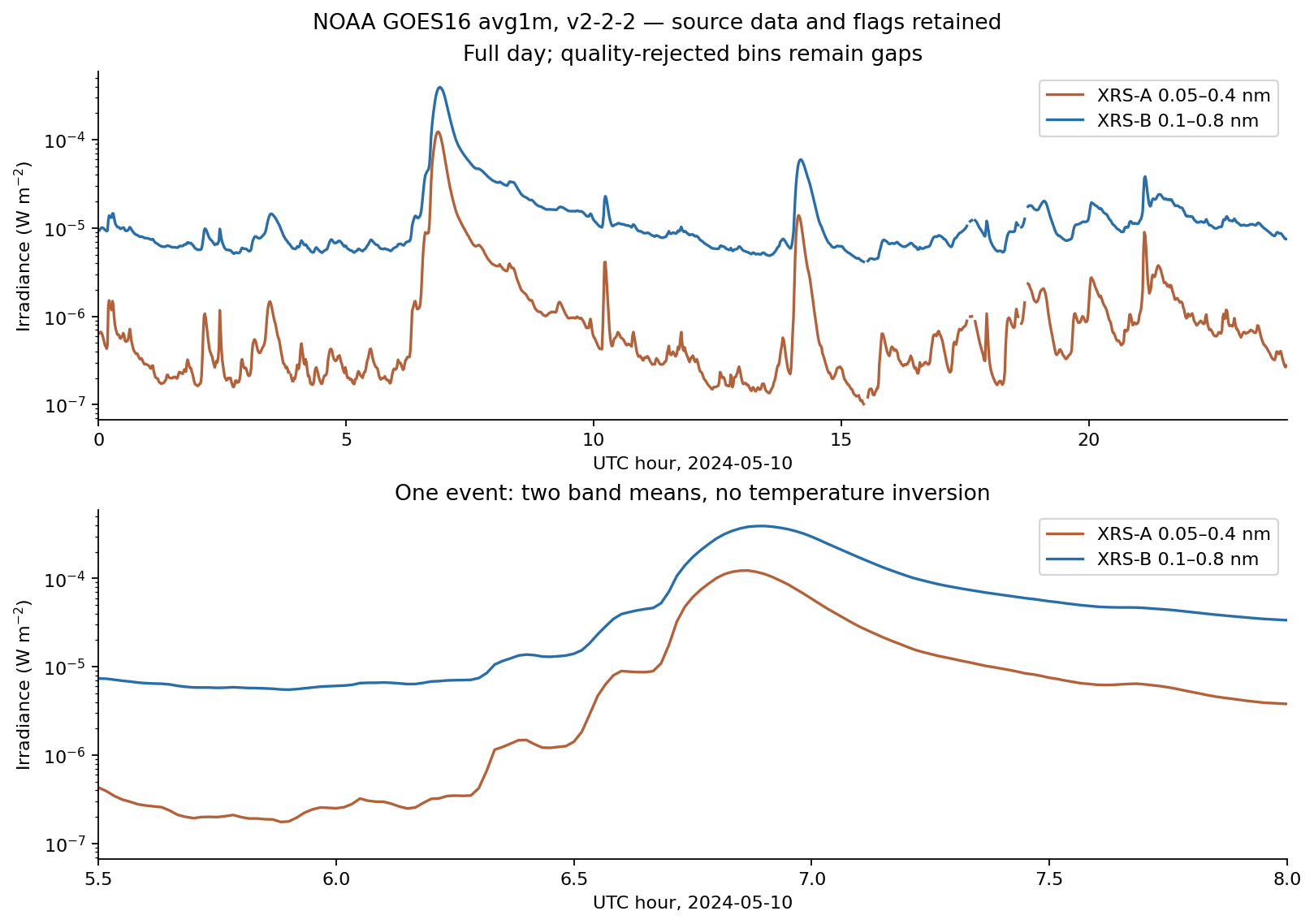
Sources: NOAA NCEI, GOES16 XRS science-quality one-minute means, 2024-05-10, v2-2-2 · NOAA, GOES-R XRS L2 Data Users Guide, §§2.1–2.4 and quality-flag tables · NOAA, GOES-R XRS L2 Data ReadMe, release v2-2-2, 6 October 2026
Define which fluence is being estimated
Irradiance times seconds has units of energy per area. Summing the minute means multiplied by 60 estimates fluence over the retained window. When all 60 samples contribute, that uses the reported full-bin mean. With 54–59 samples, it assumes the available seconds represent the full minute.
For A, the full-minute estimate is , whereas weighting each mean by its available sample count gives a separately named proxy . Their difference is not an uncertainty bound on the five missing seconds. The full-minute B estimate is .
Next subtract a specified background: 05:30–05:50 or 05:40–06:00, using either a mean or a median. These four choices give B signed excess fluence about 0.606–0.610 joules per square metre. Positive-only clipping is printed separately because it changes the estimator.
The source au_factor gives a distinct one-AU-corrected result. Native flux is not already corrected by that factor. No historical scaling from the older GOES8–15 series is applied to this GOES-R science product. These background and correction choices are sensitivity scenarios, not a confidence interval.
Sources: NOAA, GOES-R XRS L2 Data Users Guide, §§2.1–2.4 and quality-flag tables · NOAA NCEI, GOES16 XRS science-quality one-minute means, 2024-05-10, v2-2-2
Carry the definition into the physical conclusion
The resulting fluence concerns these bands, this observer geometry, this chosen interval and the stated within-bin assumptions. It is not total flare radiation or released magnetic energy. Two band signals alone also do not supply a calibrated temperature/emission-measure inference in this exercise.
A comparison with the MHD heat record would need a radiation calculation: density and thermodynamics, conduction, emission and the instrument response. The present model supplies a field/fluid energy-conversion problem; this tutorial supplies actual measured X-ray-band signals. Each has a complete reproducible path to its own result.
For the next mission file, keep the same sequence: exact input/version, clock, band definition, flags, contributing exposure, estimator, background and physical interpretation. Those choices should travel with every quoted number.
Sources: NOAA, GOES-R XRS L2 Data Users Guide, §§2.1–2.4 and quality-flag tables · NOAA, GOES-R XRS L2 Data ReadMe, release v2-2-2, 6 October 2026