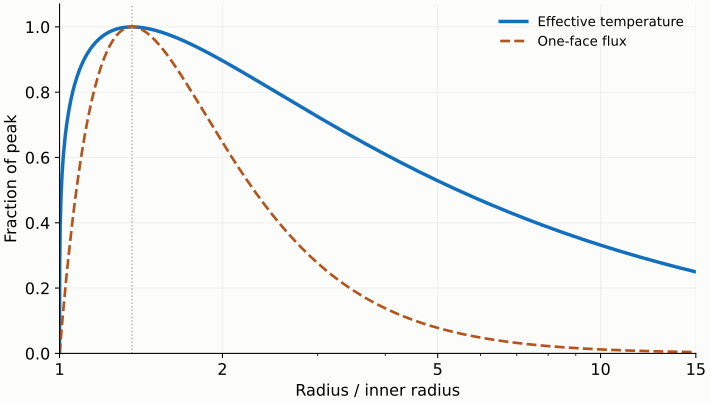
The heating of a thin disk depends on the torque between neighbouring rings and their difference in orbital rate. The faster inner ring gives up more orbital energy than the slower outer ring receives. The difference becomes heat. With zero torque at the inner edge, the local radiation also falls to zero there, and the hottest ring lies a little farther out.
Read Why gas around a black hole shines first. This chapter also uses circular motion, torque and power. We introduce the derivatives and integrals needed for the argument as they appear. The goal is to derive the heating per unit surface area and explain why the innermost gas need not be the locally hottest gas.
Mass moves inward; angular momentum moves outward
Consider a flat, very thin disk around a central mass M. The coordinate R, in metres, measures radius in the disk plane. We use Newtonian gravity, with gravitational constant G, and nearly circular orbits. We neglect the radial pressure correction to the orbital speed. The angular frequency and angular momentum per unit mass are
Ω(R)=R3GM,ℓ(R)=R2Ω(R)=GMR.
The angular frequency Ω measures the angle travelled each second, in radians per second. The specific angular momentum ℓ has units of square metres per second. Inner rings turn faster, but each kilogram there carries less angular momentum.
Let M˙>0 be the mass flowing inward through a circle each second, in kilograms per second. The dot denotes a rate in time. In a steady disk, gas does not accumulate between rings. The same mass rate therefore passes every radius.
The gas carries angular momentum inward. The internal torque carries it outward. Write the outward torque as G(R), in newton metres. The net inward angular-momentum flow must be the same at every radius:
M˙ℓ(R)−G(R)=constant.
Let the inner disk radius be Rin. Setting the torque there to zero fixes the constant to M˙ℓ(Rin), giving
G(R)=M˙[ℓ(R)−ℓ(Rin)].
Zero inner torque does not remove the angular momentum of the entering gas. Gas still carries ℓ(Rin) across the edge. The boundary condition sets the additional torque transport to zero there. Section 2 of Zimmerman and colleagues' paper develops the thin-disk temperature profile using these steady-flow and boundary assumptions.
Why torque leaves heat behind
Torque multiplied by angular frequency gives power. Consider a narrow annulus between R and R+dR. The same outward transfer of angular momentum takes energy from the faster side and delivers energy to the slower side. The difference in their orbital rates gives the heating:
dLheat=G(R)[−dRdΩ]dR.
The derivative dΩ/dR is the change in orbital frequency divided by the change in radius as the annulus becomes very narrow. Keplerian frequency decreases outward, so this derivative is negative. The minus sign makes the heating positive.
Each face of the annulus has area approximately 2πRdR. Its two faces have total area 4πRdR. Assume the heat is radiated locally and equally through the two faces. The radiated power per unit area of one face is
F(R)=4πRG(R)[−dRdΩ]=8πR33GMM˙(1−RRin).
Its units are watts per square metre. We have already divided the heat between the faces. To find the whole disk's luminosity, we will multiply this one-face flux by the actual area of both faces. To find the local surface temperature, we use F directly.
This calculation assumes efficient local cooling. It neglects heat carried inward by the gas and irradiation from elsewhere. Torque also transports energy between radii. Finding the local heat requires both the orbital-energy change and the energy transported by torque.
Finding the hottest ring
Effective temperature Teff is defined from the total radiated power. With Stefan–Boltzmann constant σ,
Teff(R)=[σF(R)]1/4.
This definition uses energy summed over all frequencies. The colour temperature that describes the spectrum enters in the next chapter. Equations E4–E5 of Li and colleagues' Appendix E make that distinction explicit.
Two factors compete in the flux. The factor R−3 favours the inner disk. The boundary factor in parentheses suppresses the inner edge. Set x=R/Rin. The maximum occurs where the slope of x−3(1−x−1/2) vanishes:
−3x−4+27x−9/2=0,x=3649.
The hottest ring lies at about 1.36 times the inner radius. The dim inner edge follows from the heating boundary condition. It is distinct from the black hole's event horizon.
Figure 1. Ideal thin-disk reference. Radius is measured in units of the chosen inner radius. The saved local-emission model supplies the temperature. Relative one-face flux is plotted alongside it to show how the fourth root reduces the temperature variation.
Choose M=2.00×1031kg and M˙=1.00×10¹⁴kgs−1. Define the gravitational length rg=GM/c2, where c is the speed of light. Take Rin=6rg and Rout=6000rg. First calculate the radius of the hottest ring, then its flux, then the fourth root:
A fourth root changes slowly. Doubling the accretion rate doubles the flux everywhere but raises the temperature by only about 19%. The peak stays at the same radius because the radial shape has not changed.
Here the Newtonian heating law is prescribed down to the chosen inner edge. Later light propagation uses Schwarzschild spacetime. The local heating is not a full relativistic thin-disk solution. This teaching combination lets us study emission and propagation separately.
The luminosity of both faces
An integral adds the power from all the narrow annuli. Multiply the one-face flux by the area of both faces:
Ltwofaces=∫RinRout4πRF(R)dR.
Substitute the flux above and set q=Rin/Rout. The result is
Ltwofaces=2RinGMM˙(1−3q+2q3/2).
An infinitely extended outer disk makes the bracket approach one. A finite outer radius removes some emission from the coolest outer rings and lowers the luminosity slightly. For the example, the radius ratio is one thousandth. The bracket is about 0.997063, giving a two-face power of 7.47×1029W.
This is the local power released by the prescribed heating law, summed over the disk. The amount received far away in a particular direction and aperture also depends on light paths, frequency shifts and viewing angle. The next chapter first divides the local power into radiation at different frequencies.
Exercises with explanations
1. Can mass cross an inner edge whose local heating is zero?
Yes. Mass flow and local torque are different quantities. Gas crosses the edge with nonzero orbital angular momentum. The boundary condition only makes the torque vanish there.
2. Increase the accretion rate by a factor of 16. What happens to maximum temperature and luminosity?
Keep mass and radii fixed. Flux is proportional to accretion rate, and temperature is its fourth root. The maximum temperature doubles and the luminosity increases sixteenfold. This calculation still requires a thin disk with efficient local radiation; a higher rate that breaks those assumptions needs another model.
3. A calculated temperature map is hottest at its inner edge. What would you inspect first?
Check the inner heating condition. Additional inner torque can heat the edge; the zero-torque model must fall to zero there. Then check whether the plotted quantity is local temperature, radiation per unit area or an image after light propagation. Those plots answer different questions.
4. Transfer problem: double the inner radius at fixed mass and accretion rate. How do maximum temperature and infinite-outer-radius luminosity change?
The dimensionless peak position stays fixed. The flux scale varies as the inverse cube of inner radius, so the maximum temperature becomes 2−3/4≈0.595 of its old value. The luminosity is inversely proportional to inner radius and halves. This is an analytic comparison of emission laws. The interactive experiment's current discrete states all use Rin=6rg.