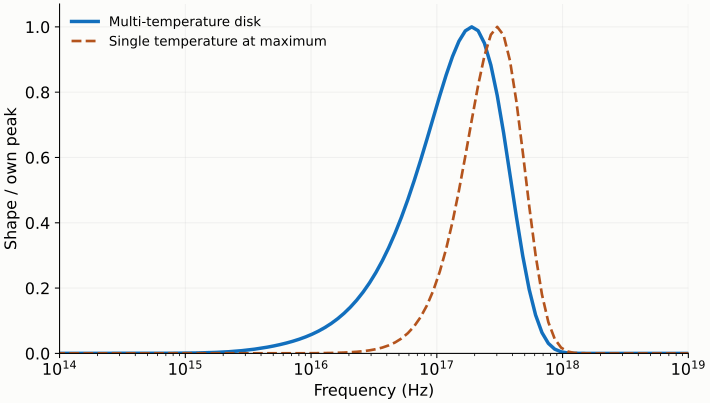
A disk's broad thermal spectrum is the sum of radiation from rings at different temperatures. Each ring has its own spectral shape, and its contribution also depends on its area. Small, hot inner rings can supply high-frequency light. Large, cool outer rings can supply a substantial share at low frequencies.
The previous chapter found the total surface power and effective temperature at each radius. We now distribute that power over frequency and add the rings. You will need frequency, temperature, annular area and the idea of an integral as a sum of small contributions. The goal is to distinguish local intensity, surface flux, two-face luminosity and received flux, then predict how an increased accretion rate moves the spectrum.
Start with a surface and a direction
Take a small surface patch at one radius. Let ν be frequency, in hertz. The specific intensity of a perfect blackbody is
Bν(T)=c22hν3exp[hν/(kBT)]−11.
Here h is Planck's constant, kB is Boltzmann's constant, c is the speed of light and T is temperature. The ratio in the exponential compares one photon's energy with the thermal energy scale. When that ratio is large, photons of that energy become scarce and the curve falls rapidly.
Specific intensity has units of Wm−2sr−1Hz−1. It describes power in a particular direction, per unit area perpendicular to the ray, per unit range of directions and per unit frequency. That range of directions is measured by solid angle, in steradians. A larger patch of your sky occupies a larger solid angle.
The outward flux of the surface must add all outgoing directions. Oblique rays require a projection factor. For intensity that is uniform over direction, the angular integral supplies a factor of π:
Fν=∫outwardhemisphereIνcosθdΩ=πIν.
The angle θ is measured from the surface normal, and Ω denotes solid angle. Intensity and surface flux both describe brightness, but flux includes this direction integral. Treating intensity itself as one-face flux misses the factor.
A harder spectrum can preserve the total power
Effective temperature is defined from total power. A simple approximation to changes in the radiation emerging from a disk atmosphere uses a higher colour temperature:
Tcol=fcolTeff.
The prescribed hardening factor fcol moves the spectrum toward higher frequencies. Raising the Planck temperature alone would also raise the total power as the fourth power of temperature, exceeding the heat supplied in the previous chapter. We therefore include a dilution factor:
Iν,em=fcol−4Bν(fcolTeff).
Integrating over frequency and outgoing directions gives
π∫0∞Iν,emdν=fcol−4σ(fcolTeff)4=σTeff4.
The total power returns to its original value, but its distribution over frequency changes. This prescribed correction lets us explore spectral changes before solving the full absorption and scattering problem in a disk atmosphere. Equations E4–E7 of Li and colleagues' Appendix E relate effective temperature, colour temperature and diluted intensity. Their natural-unit expressions differ from the SI formula above, which retains Planck's constant and the speed of light.
For example, an effective temperature of 2.18 million kelvin and a hardening factor of 1.7 give a colour temperature of about 3.70 million kelvin. The one-face total power supplied by the heating model stays the same.
Why outer rings matter at low frequencies
A ring at radius R, with width dR, has area 2πRdR on each face. The spectral luminosity of both faces is
Lν=∫RinRout4π2RIν,em(R)dR.
One factor of π comes from the angular integral of each emitting surface. The other comes from the ring area. The expression counts both disk faces.
Figure 2. Ideal emission reference. The vertical axis gives radiation per logarithmic frequency interval, with each curve divided by its own peak. The blue curve uses the saved two-face disk spectrum. The dashed curve is a single-temperature Planck shape at the maximum colour temperature. Black-hole light propagation has not been applied.
The blue curve is broader on its low-frequency side because the disk contains many rings cooler than the maximum temperature. Those rings still emit substantial low-frequency light. Their large surface areas can compensate for lower brightness per unit area.
Consider two rings with the same small fractional width: each width is the same fraction of its radius. If the second ring is 16 times farther out, its area is 256 times larger. Far from the inner edge, temperature falls approximately as radius to the power minus three quarters. The second ring is then about eight times cooler.
At frequencies low enough that both rings satisfy hν≪kBTcol, Planck intensity is approximately proportional to temperature. The cooler ring has about one eighth the intensity per unit area, yet its total contribution is about 32 times larger. At higher frequencies it enters the exponentially falling part of its spectrum. The estimate then fails, and the hot inner rings become more important.
What reaches one distant observer
A distant observer receives only the light directed toward them. Begin with straight light paths. Let D be distance, and i the angle between the disk normal and the line of sight. A complete ring subtends approximately
dΩsky=D22πRcosidR
on the sky. Its contribution to received spectral flux is intensity times this solid angle, giving
Fν,obsflat=D22πcosi∫RinRoutRIν,em(R)dR.
Received flux has units of Wm−2Hz−1. It measures power arriving per unit observer area, with no remaining “per steradian.” Direction, distance and the visible surface distinguish it from the two-face luminosity. Zimmerman and colleagues' equations 6–8 likewise distinguish the observed spectrum from total disk luminosity.
A finite aperture selects only part of the sky. The integral must then include only disk light that lands inside it. Losing outer rings can particularly affect low-frequency radiation. Comparisons between propagation methods should use the same region of the observer's sky.
Near a black hole, curved paths, gravitational frequency shifts and the gas's motion modify this straight-path picture. Later chapters follow each direction to its first encounter with an opaque disk surface, then calculate the received intensity. The companion image displays a smaller central crop, while its spectrum covers a larger fixed sky aperture. The spectrum retains the light from the full fixed aperture when the displayed image is cropped.
Worked example: double the supply of gas
Keep mass, radii, hardening and propagation geometry fixed. Multiply the accretion rate by μ. The previous chapter gives
Teff,μ(R)=μ1/4Teff,1(R).
For μ=2, every ring warms by about 19%. Each Planck spectrum shifts toward higher frequency and rises. Substituting into the Planck expression gives the complete disk relation
Lν,μ(ν)=μ3/4Lν,1(μ1/4ν).
Both axes change. Integrating over frequency introduces the extra frequency-scale factor, so total luminosity increases by exactly μ. The brightness at every individual frequency generally does not double.
The same relation holds for fixed propagation geometry that is independent of accretion rate. The companion calculation saves half, reference and double accretion rates at three viewing angles, with the same inner radius throughout. At 60 degrees, the frequency-integrated received flux from the resolved part of the fixed aperture is:
Accretion-rate multiplier
Received total flux
μ=1
5.58×10⁻¹²Wm−2
μ=2
1.12×10⁻¹¹Wm−2
These saved values have the expected factor of two. A very narrow unresolved band around critical light paths has a separate upper bound; the table gives the integrated part. The table sums all frequencies in the same aperture.
Exercises with explanations
1. Increase the hardening factor from 1 to 2 at fixed effective temperature. What happens to colour temperature and total surface flux?
Colour temperature doubles. The dilution factor becomes one sixteenth, exactly cancelling the sixteenfold increase from temperature to the fourth power. Total flux stays fixed. Changing only the Planck temperature would overestimate the energy by a factor of 16.
2. Double the distance without changing the disk. What happens to spectral shape and received flux?
In the distant, small-angle approximation, each surface element subtends one quarter of its previous solid angle. Received flux falls to one quarter at every frequency, leaving the shape unchanged. The disk's two-face luminosity stays fixed.
3. A student integrates Fν directly over wavelength to obtain total power. What must change?
Per-frequency and per-wavelength spectra use different bin widths. They must satisfy Fλ∣dλ∣=Fν∣dν∣. With ν=c/λ, this gives Fλ=Fνc/λ2. Convert to flux per unit wavelength before integrating over wavelength. The peaks of the two spectral-density plots also need not correspond by a direct frequency-to-wavelength substitution.
4. Transfer problem: remove the coolest outer rings. Which end of the spectrum should change most?
Predict a stronger effect at low frequencies. Explain it using both temperature and area: the cool rings cover a large area and still supply low-frequency photons, whereas their high-frequency emission was already exponentially suppressed. This reasoning applies to the thermal disk here. Additional irradiation, spectral lines or dust emission require their own emission calculations.