A generation returns old material as well as new elements
Suppose a million solar masses of gas form stars. In the instantaneous-recycling approximation used here, a fraction 0.4 is returned immediately and 0.6 remains locked in long-lived stars and remnants. The approximation combines processes with different actual lifetimes into an effective return fraction. It is not a claim that every star instantly ejects forty percent of its mass.
If the initial iron mass fraction was 0.001, that generation inherited a thousand solar masses of iron. Four hundred return with the recycled material and six hundred remain locked. Newly synthesized iron is an additional contribution. The fixed core-collapse net yield is 0.000246 per unit total mass formed, so this generation supplies 246 solar masses of new iron. Multiplying this yield by 0.4 again would undercount the new iron; it is already defined per unit total mass formed.
The effective yields are fixed to the declared VICE 1.3.1 input convention. They assume a particular Kroupa stellar-mass distribution and do not open a new grid of progenitor yields. The delayed magnesium yield is small but nonzero.
Reading: VICE v1.3.1 fixed effective yields and solar reference · Weinberg, Andrews & Freudenburg, Equilibrium and Non-Equilibrium Aspects of Galactic Chemical Evolution, arXiv:1604.07435v1
Write the total-gas rate first
Let be gas mass, the total rate at which gas forms stars, the inflow rate, and the outflow mass per unit mass of stars formed. A wind rate of times has units of mass per time, just like the other terms. With return fraction , only one minus is permanently removed into stars in this approximation.
Reading: Independent one-zone chemical-evolution Python materials · Weinberg, Andrews & Freudenburg, Equilibrium and Non-Equilibrium Aspects of Galactic Chemical Evolution, arXiv:1604.07435v1
Now follow one element through those same flows
Write the element mass in the gas as times , where is its mass fraction. A well-mixed wind removes gas at the current gas composition; locking material into stars does the same. Let be the rate of newly synthesized element input and let the inflow have element fraction . Both equations use the same gas composition and flow rates.
Reading: Independent one-zone chemical-evolution Python materials · Weinberg, Andrews & Freudenburg, Equilibrium and Non-Equilibrium Aspects of Galactic Chemical Evolution, arXiv:1604.07435v1
A complete numerical step, before any integration
Take ten million solar masses of gas with iron fraction 0.001. Let one solar mass per year form stars, no gas enter, and equal 0.5. Consider only the prompt iron source for this calculation. The gas decreases by 1.1 solar masses per year: 0.6 is locked and 0.5 leaves in the wind.
The prompt source adds 0.000246 solar masses of iron per year, while locking and wind remove 0.0011. The iron inventory therefore decreases by 0.000854 solar masses per year. Yet the iron fraction increases, because the total gas reservoir shrinks as well. An inventory and a fraction answer different questions.
The product rule says that the change in equals times the change in plus times the change in . Substituting the two ledgers cancels the composition-matched removal terms. With metal-free inflow the remaining equation is:
Reading: Independent one-zone chemical-evolution Python materials
Why the wind can raise abundance at a fixed time
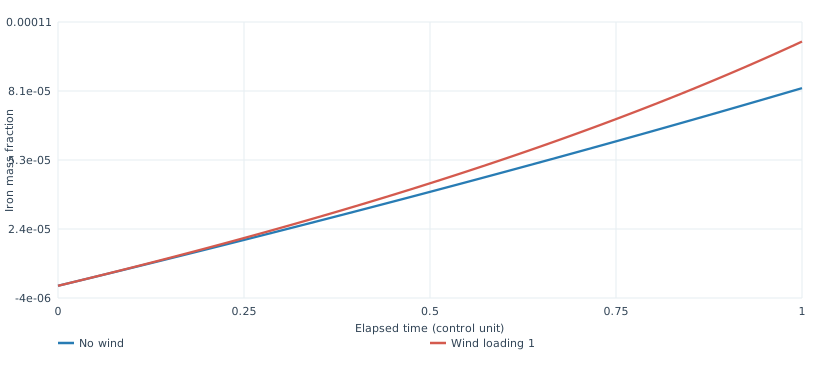
The cancellation does not make the wind irrelevant. Changing the wind loading changes , the mass of gas into which a given source is mixed. In this family the star-formation history is prescribed independently of the remaining gas, provided the reservoir stays positive. A stronger wind can therefore leave less gas to receive the same new element mass and raise its fraction at a specified time.
A separate prompt-only control starts with unit gas, iron fraction one millionth, and a constant formation rate of 0.3 per time unit. After one time unit, zero leaves gas 0.82 and iron fraction about 0.00008236. A wind loading of leaves gas 0.52 and iron fraction about 0.00010154. Both are valid budgets; the latter has less gas and a higher iron fraction.
At the same remaining gas fraction, the conclusion changes: a stronger well-mixed wind reduces the effective yield per logarithmic gas depletion. Always state what is held fixed. Tying the formation rate to gas mass requires solving that relation too, and can change the resulting history.

Reading: Independent one-zone chemical-evolution Python materials · Weinberg, Andrews & Freudenburg, Equilibrium and Non-Equilibrium Aspects of Galactic Chemical Evolution, arXiv:1604.07435v1
What this first ledger leaves out
The gas is one mixed reservoir. Outflows carry the current reservoir composition; a preferentially metal-rich wind would require a different element-loss term. The fixed return approximation, trace-element treatment and fixed hydrogen fraction do not solve a full stellar mass-return calculation or gas thermodynamics. Histories that exhaust the permitted gas reservoir are refused before integration.
A saved record carries the same gas and element inventories into its abundance track and stellar birth groups. That common record is what makes later comparisons testable. The next chapter supplies the delayed source that enters .
Reading: Independent one-zone chemical-evolution Python materials