Read the light before reading the history
A stellar spectrum contains absorption lines produced by atoms in the atmosphere. Measuring their strengths, together with a model of that atmosphere, lets astronomers estimate elemental abundances. These estimates have errors: a stronger line is not simply a larger number of atoms, because temperature, pressure and line formation matter too.
The bracket notation compares the number ratio in a star with the corresponding solar ratio. A value of zero means the solar ratio, not an absence of magnesium. An increase of one dex means a factor of ten. If a star has three times the solar magnesium-to-iron ratio, its bracket value is about 0.477 dex.
Reading: Hill et al., VLT/FLAMES high-resolution chemical abundances in Sculptor, arXiv:1812.01486v2
Two sources deliver elements on different schedules
Massive stars live briefly and can end in core-collapse supernovae. Their freshly made magnesium and iron can enter the surrounding gas while star formation is still underway. Some smaller stars instead leave white dwarfs, compact stellar remnants. In suitable binary systems, a white dwarf can eventually produce a Type Ia supernova. That contribution arrives over a broad distribution of delays.
The distinction is about relative yields and timing. Core-collapse events make iron as well as magnesium; Type Ia events need not make exactly zero magnesium. The fixed teaching inputs used here retain a small Type Ia magnesium yield. A high magnesium-to-iron ratio describes their relative amounts, and can coexist with substantial iron.
Reading: Weinberg, Andrews & Freudenburg, Equilibrium and Non-Equilibrium Aspects of Galactic Chemical Evolution, arXiv:1604.07435v1 · VICE v1.3.1 fixed effective yields and solar reference
Why a long-lived population can bend downward
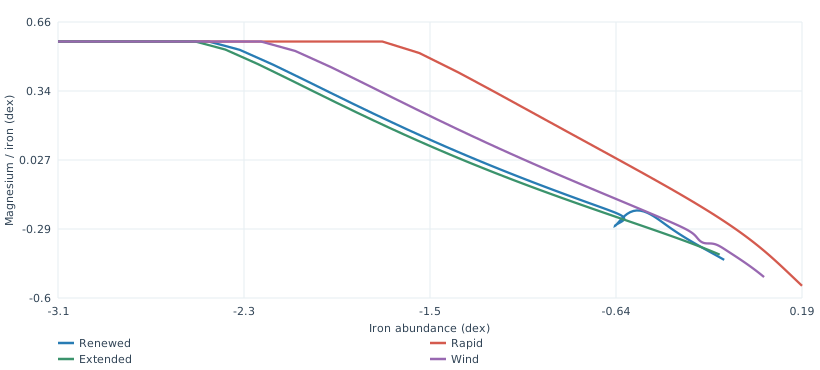
Imagine that most stars form in a brief episode. Many inherit gas dominated by the earlier, relatively magnesium-rich source. Delayed explosions can continue after the episode ends, but they cannot alter the birth composition of stars that have already formed.
Now let star formation continue. Later stars can inherit gas with a larger delayed iron contribution, so their magnesium-to-iron ratios fall. A bend in a population diagram can reveal this change of balance. It is not the exact moment of the first Type Ia explosion, and the horizontal iron abundance is not an independently measured time coordinate.
Fresh gas can dilute the reservoir. A changing formation rate alters how many stars sample each part of the track. Outflows change the gas remaining to receive new elements. A track can even turn back in iron abundance. Reading it as a single universal clock would discard these possibilities.

The stars we observe are a selected memory
Hill and collaborators published a detailed chemical study of 99 red giants in the Sculptor dwarf spheroidal galaxy. A red giant is a luminous late evolutionary stage, which makes these stars useful targets at large distances. The sample is not a complete census of all the stars ever born there. Its brightness, position, membership and spectral-quality selection affect the population we see.
A one-zone calculation treats the gas as uniformly mixed at each time. It can connect source timing, gas supply and the birth compositions of stellar groups. It cannot turn an observed abundance trend into a unique star-formation history without a selection model, measurement uncertainties and additional physical assumptions.
The next chapter starts with a more modest question that we can answer exactly: when stars form, which gas is merely recycled, which elements are newly made, and where does each part go?
Reading: Hill et al., VLT/FLAMES high-resolution chemical abundances in Sculptor, arXiv:1812.01486v2 · Weinberg, Andrews & Freudenburg, Equilibrium and Non-Equilibrium Aspects of Galactic Chemical Evolution, arXiv:1604.07435v1