Choose an energy reservoir before assigning a time
Take a fixed amount of dense carbon matter. Let its volume and composition remain unchanged, and give it a uniform temperature. These restrictions remove contraction work and composition changes from the first calculation. We also set nuclear heating and neutrino losses to zero. The remaining problem is to balance the decline of thermal energy against the light leaving the object.
Write the thermal energy as in ergs, temperature in kelvin and outward luminosity in ergs per second. One erg is one ten-millionth of a joule. Define the heat capacity : it is the extra energy required to increase this fixed object’s temperature by one kelvin.
A positive luminosity removes energy. Consequently temperature falls when the heat capacity is positive. That sign matters: a solution in which an isolated object warms while radiating would require an additional energy source. When heat capacity and luminosity are approximately constant over a stated interval, the time follows directly from the energy lost.
Sources: Mestel 1952, On the theory of white dwarf stars, MNRAS112583–597, thermal §§2–4 · Bauer 2023, Carbon-Oxygen Phase Separation in MESA White Dwarf Models, arXiv2303.10110v2, Eq1–8 and §§2–5
The electrons that support the star are strongly degenerate
Electron degeneracy means the low-energy quantum states are densely occupied. Compression forces electrons into states with higher momentum, producing pressure even when the thermal temperature is low. A large supporting pressure can therefore survive as the star cools.
Heating such electrons mainly changes the occupation of states near the boundary between filled and empty states. It does not give every electron the full thermal freedom of a dilute gas. Their heat capacity can be small compared with what a classical gas estimate would suggest, and falls with temperature in the strongly degenerate limit.
The ions carry a different reservoir. Their motion and interactions store thermal energy, while the electrons supply much of the pressure and transport heat efficiently. Later in cooling, the ionic heat capacity drops as the solid’s vibrations become quantum mechanical; the remaining electron term can become comparatively important. The temperature and density determine which component holds more thermal energy.
Sources: Mestel 1952, On the theory of white dwarf stars, MNRAS112583–597, thermal §§2–4 · Bauer 2023, Carbon-Oxygen Phase Separation in MESA White Dwarf Models, arXiv2303.10110v2, Eq1–8 and §§2–5 · MIST white dwarf models, arXiv2509.21717v1, cooling clocks, surface boundary and model comparisons
Count ions, then specify their heat capacity
Let the matter have total mass and consist of nuclei with mass number . With atomic mass unit in grams, the ion count is approximately mass divided by the mass of one nucleus. For pure carbon, the mass number is twelve.
Heat capacity needs another physical assumption. A dilute monatomic gas has three kinetic degrees of freedom and a heat capacity of one and a half times the ion count times Boltzmann’s constant. In a classical harmonic solid, kinetic and potential energy both contribute, giving three times that product at sufficiently high temperature. These two results describe different material states.
The controlled core model adopts the latter constant value for its liquid sensible branch and uses a Debye solid below melting. That liquid choice is an explicit approximation, not a derivation of the exact heat capacity of a strongly interacting plasma. A detailed stellar EOS calculates the thermal response from a more complete description of the material.
Sources: Mestel 1952, On the theory of white dwarf stars, MNRAS112583–597, thermal §§2–4 · Bauer 2023, Carbon-Oxygen Phase Separation in MESA White Dwarf Models, arXiv2303.10110v2, Eq1–8 and §§2–5 · MESA 22.11.1 fixed const_def.f90, matching original source units
A first cooling-time calculation
Consider a hypothetical pure-carbon reservoir with mass . For this exercise specify and a constant luminosity . Let it cool through one million kelvin without a phase transition. These are the problem’s assumptions; we are not assigning an observed white dwarf that age.
Using the declared MESA units, , and , the reservoir contains about ions. Its specified heat capacity is .
Multiply that heat capacity by the temperature drop to get . Divide by and then by the seconds in a year. The result is about , or 205 million years. The units cancel to time; the result is positive because the final temperature is lower.
Doubling the specified luminosity halves this interval. Doubling the mass would double the specified heat reservoir, but it would not necessarily double the age of a real white dwarf: a different stellar mass also changes density, radius and luminosity. The simple calculation teaches how energy becomes a time only after the model’s other quantities are fixed.
Sources: MESA 22.11.1 fixed const_def.f90, matching original source units · Mestel 1952, On the theory of white dwarf stars, MNRAS112583–597, thermal §§2–4
Connect the core to the light at the surface
A white dwarf is not an exposed lump with a chosen constant luminosity. Heat crosses the outer layers before escaping. A surface atmosphere supplies a relation among effective temperature, gravity and outgoing radiation, while the deeper envelope connects that surface to the hot interior.
The effective surface temperature is defined through the total outgoing flux. For radius and Stefan–Boltzmann constant , the relation below defines the luminosity. It does not say that the observed spectrum is a perfect blackbody, nor that the core has the same temperature.
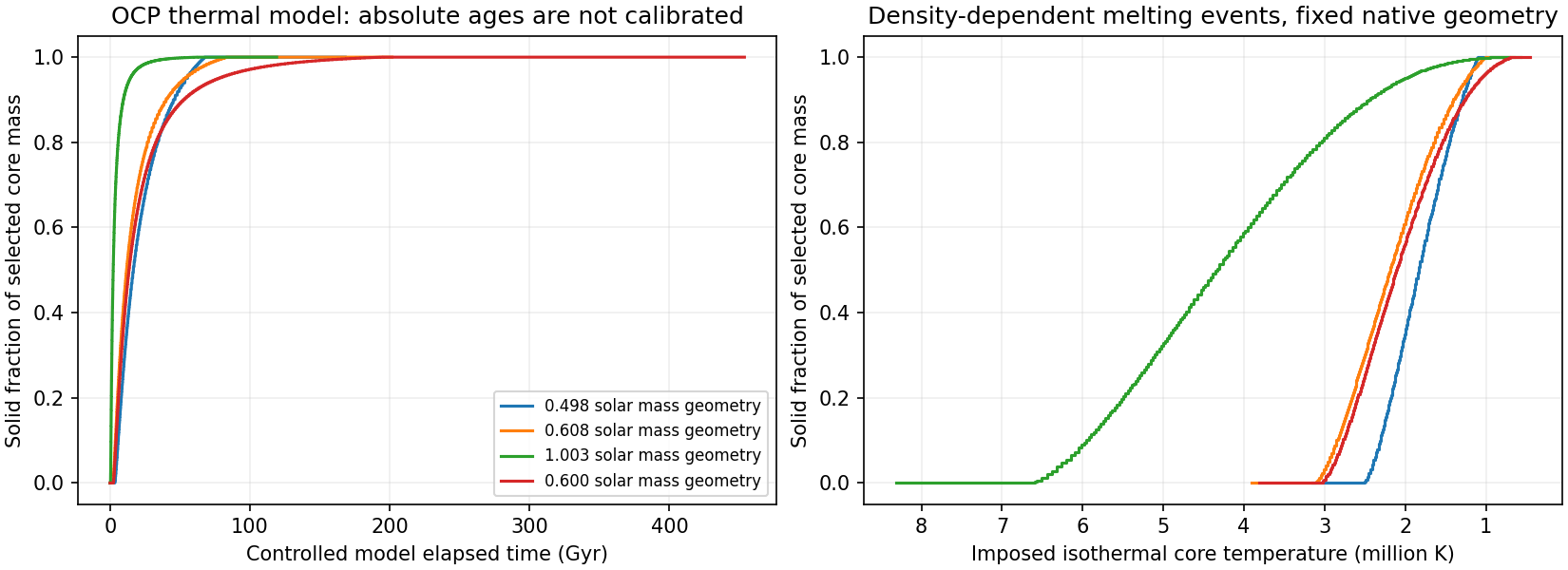
The next chapter derives a controlled radiative-envelope relation and then adds freezing. A full white-dwarf calculation uses a stellar structure and EOS together with appropriate atmospheric boundary conditions. The long controlled-model clocks in the figure are left visible because a consistent energy calculation alone does not calibrate an actual stellar age.
Sources: Mestel 1952, On the theory of white dwarf stars, MNRAS112583–597, thermal §§2–4 · MIST white dwarf models, arXiv2509.21717v1, cooling clocks, surface boundary and model comparisons · Bauer 2023, fixed MESA inputs and starting models, Zenodo 7846751, CC BY 4.0