The furnace stops before the light does
Take a piece of hot metal out of a furnace. It does not become cold as soon as the fire is gone. Energy stored in the metal continues to leave as light and heat. A cooling white dwarf follows the same broad energy argument, although its material is far denser and the cooling can take billions of years.
The Sun will eventually leave behind a compact remnant after shedding its outer layers. The remnant contains a substantial fraction of a star’s mass in a body comparable in size to Earth. For the ordinary, non-accreting remnants considered here, stored energy provides most of the light at late times. Residual hydrogen burning can still matter in some models, especially for certain low-metallicity progenitors.
The remnant does not need a blazing furnace to avoid collapsing. Its crowded electrons resist further compression through a quantum effect called degeneracy pressure. Support against gravity and the supply of thermal energy are different jobs. Much of the useful heat reservoir lies in the ions, the positively charged atomic nuclei, while electrons can also contribute to the heat capacity.
That separation is why cooling need not cause a dramatic shrinking of the star. The object can remain almost the same size while gradually changing temperature. Even a faint remnant is still releasing energy stored over its long thermal history.
Sources: Mestel 1952, On the theory of white dwarf stars, MNRAS112583–597, thermal §§2–4 · Bauer 2023, Carbon-Oxygen Phase Separation in MESA White Dwarf Models, arXiv2303.10110v2, Eq1–8 and §§2–5 · MIST white dwarf models, arXiv2509.21717v1, cooling clocks, surface boundary and model comparisons
The surface only shows the escaping heat
A white dwarf’s interior can be much hotter than its surface. Electrons transport heat efficiently through the dense core, making an approximately uniform core temperature a useful starting picture. The outer layers control how readily that heat reaches space. Their composition changes the relation between internal temperature and emitted light.
A measured colour mostly tells us about the light leaving the atmosphere. It does not directly reveal the core temperature. To connect colour to internal heat, astronomers combine a structure and cooling calculation with an atmosphere model. The mass matters because it changes density, radius and the conditions under which the material freezes.
Imagine placing the same warm object behind two different insulating layers. Equal internal temperatures need not produce equal outward heat flow. The stellar calculation is more complicated than a jacket, but the analogy explains why changing an envelope assumption changes an inferred cooling time. A brightness measurement becomes a clock reading only after that connection has been specified.
Sources: Mestel 1952, On the theory of white dwarf stars, MNRAS112583–597, thermal §§2–4 · MIST white dwarf models, arXiv2509.21717v1, cooling clocks, surface boundary and model comparisons
Freezing adds a pause to the cooling
Dense white-dwarf matter is a plasma: electrons move among charged nuclei. As it cools, the nuclei can settle into an ordered solid. This crystallization is a freezing transition, even though it takes place at temperatures that would destroy familiar materials on Earth. High density makes the electrical interactions between neighbouring ions strong enough to organize them.
Freezing releases latent heat. The name refers to energy released during a change of phase while the temperature can remain nearly fixed. Water freezing in a container gives a familiar example. In a white dwarf, a shell can keep sending energy outward while its ions finish arranging themselves into a solid. The extra release delays the fall in temperature.
The center is denser than the outer core, so its material generally freezes at a higher temperature. An ordinary solid core grows outward as the star cools. A radial cutaway helps us follow that progression. The solid mass fraction is not simply the fraction of the radius filled by solid: dense central material carries more mass than an equally thick outer layer.
Carbon and oxygen can also separate as they freeze. In an ordinary carbon–oxygen mixture, the solid becomes richer in oxygen and the surrounding liquid richer in carbon. The resulting redistribution changes the star’s energy and can slow cooling further. This energy source is distinct from latent heat. More unusual mixtures containing neon can even form buoyant crystals. Their rising and melting can drive a transport process called distillation, explored in the final reading guide.
Sources: Bauer 2023, Carbon-Oxygen Phase Separation in MESA White Dwarf Models, arXiv2303.10110v2, Eq1–8 and §§2–5 · Bédard, Blouin and Cheng 2024, Buoyant crystals halt the cooling of white dwarf stars, arXiv2409.04419v1, author manuscript of the Nature study, main text and Methods
A crowd of stars can mark a slow part of the journey
Suppose stars enter a stretch of their cooling paths at a steady rate. If each crosses it quickly, relatively few are found there at once. If they spend a long time in that stretch, many can accumulate. A concentration of stars in a colour–magnitude diagram can therefore reveal a slowdown, provided differences in birth rate, mass, atmosphere and observational selection are also considered.
The published comparison below follows three calculations with the same mass and initial composition. One omits neon distillation, one stops the process earlier, and one allows it to continue according to the authors’ prescription. The delayed curves spend much longer near a narrow luminosity range. These are model outputs; their clocks start at the first supplied cooling state.
Those curves belong to the standard-composition family in the Bédard data release. The especially long delays illustrated in the paper’s main Figure 4 use a different, thin-helium family. Keeping that distinction makes a physical question possible: which changes in composition or envelope turn a brief slowdown into a long plateau?
White dwarfs are valuable clocks because their light carries the consequences of a long, calculable loss of energy. Reading that clock means learning its mechanism. A star of a given brightness can be older if it has received an additional supply of heat on the way down.
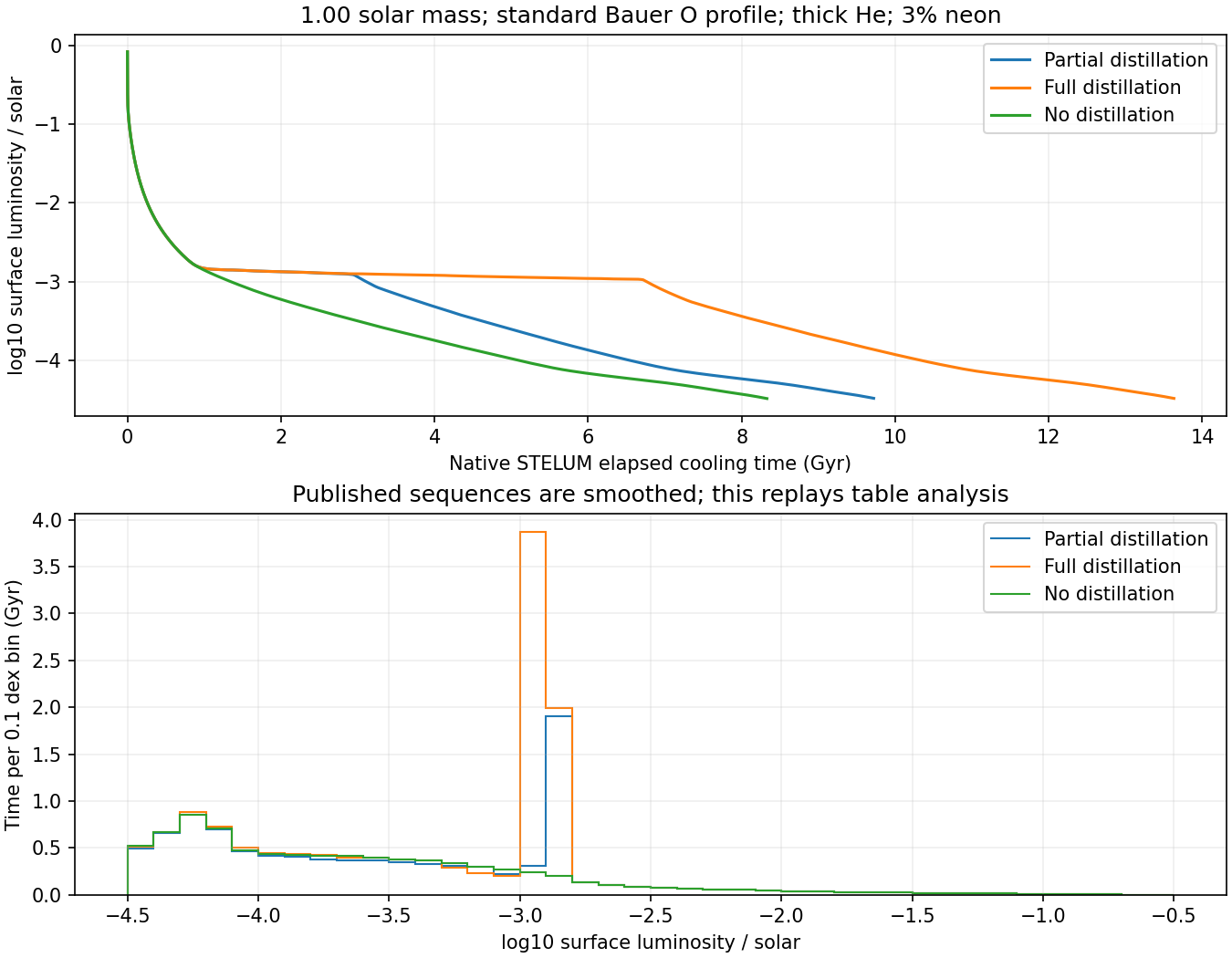
Sources: Bédard, Blouin and Cheng 2024, Buoyant crystals halt the cooling of white dwarf stars, arXiv2409.04419v1, author manuscript of the Nature study, main text and Methods · Bédard, Blouin and Cheng 2024, fixed cooling sequences, Zenodo 10201676, CC BY 4.0