Compare two gravitational accelerations
The cluster centre and a star near its edge both feel the Galaxy. Their relative fate depends on the difference between those accelerations, not the total Galactic attraction. In the frame rotating with a circular cluster orbit, the centrifugal contribution also enters.
Let the circular radius be , the angular frequency , the small radial-oscillation frequency and the cluster mass . A local expansion requires a cluster much smaller than its orbital radius.
Displace a star radially by a small . The host acceleration changes by , while the centrifugal term changes by . Thus the outward coefficient is . Balance that linear term against the cluster attraction to obtain the tidal scale below.
Reading: Erkal & Belokurov (2015), Forensics of Subhalo-Stream Encounters, arXiv:1412.6035v2 · Sandbox Physics standalone stellar-stream scientific reader v1
Worked example: a ten-thousand-solar-mass cluster
For a flat circular-speed curve, increasing radius decreases angular frequency. At the same radius the radial epicyclic frequency is higher than the orbital angular frequency. Differentiating gives their relation and the tidal denominator.
Use the gravitational constant so kiloparsecs, kilometres per second and solar masses can be inserted consistently.
Reading: Erkal & Belokurov (2015), Forensics of Subhalo-Stream Encounters, arXiv:1412.6035v2 · Sandbox Physics standalone stellar-stream scientific reader v1
Where does the radial frequency come from?
For a star moving in a fixed spherical potential, conservation of angular momentum lets us write its radial motion as motion in an effective potential. The extra centrifugal term is a way of retaining the tangential motion while solving for radius. It is not an additional physical mass. For this radial derivation choose the first two axes in this star’s orbital plane and the third along its angular momentum. The normal component used below then equals the angular-momentum magnitude. Radius here is distance from the centre within that orbital plane. An inclined star’s component along the Lab reference axis cannot replace this orbital-plane normal component.
At a circular guiding radius , the first radial derivative vanishes. Displace the radius slightly while keeping the same angular momentum. Expanding the radial force to first order gives a harmonic oscillator whose squared frequency is the curvature of that effective potential. A positive curvature gives a restoring force.
This explains why two clocks enter the tidal calculation. One describes going around the centre; the other describes the small inward–outward oscillation. They coincide in some special potentials, but a flat circular-speed host has different clocks.
Reading: Erkal & Belokurov (2015), Forensics of Subhalo-Stream Encounters, arXiv:1412.6035v2 · Sandbox Physics standalone stellar-stream scientific reader v1
The same location can conceal different futures
Two neighbouring stars with slightly different velocities will not remain neighbours. We therefore need positions and their conjugate momenta together: phase space. In our inertial Cartesian specific coordinates, momentum equals velocity.
Hamiltonian motion stretches and folds a small phase-space element while preserving its phase-space volume. A one-dimensional sky count can become sparse without contradicting that statement, because the projection hides distance, velocity and other directions.
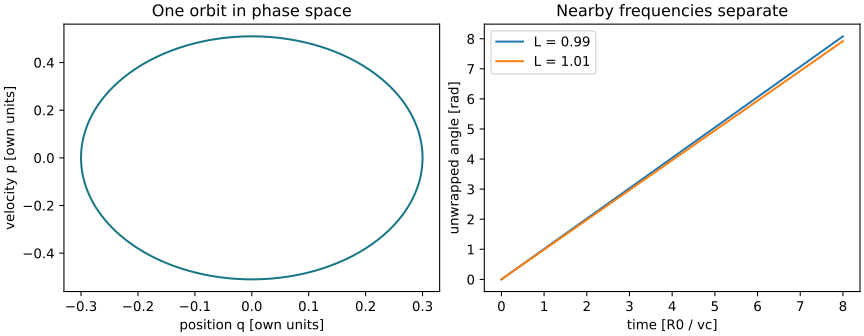
The left-hand ellipse is a harmonic oscillator in position–velocity coordinates. It is not the spatial outline of a stellar orbit.
Reading: Erkal & Belokurov (2015), Forensics of Subhalo-Stream Encounters, arXiv:1412.6035v2 · Sandbox Physics standalone stellar-stream scientific reader v1
An action measures amplitude; an angle tracks progress
For periodic motion, the area enclosed by the phase-space path provides a useful amplitude coordinate: an action. Its partner angle describes progress around a cycle. That angle need not be the visible spatial azimuth.
Reading: Erkal & Belokurov (2015), Forensics of Subhalo-Stream Encounters, arXiv:1412.6035v2 · Sandbox Physics standalone stellar-stream scientific reader v1
Worked example: one percent on either side of the reference
A nearly circular orbit in a flat-speed host has . Set the speed and length units to one, and compare with . After eight time units:
Reading: Erkal & Belokurov (2015), Forensics of Subhalo-Stream Encounters, arXiv:1412.6035v2 · Sandbox Physics standalone stellar-stream scientific reader v1
Connect the picture to the experiment
The experiment assigns 192 distinct initial states and integrates each trajectory. It omits escape from the cluster, so its initial snapshot cannot validate the tidal-radius calculation. It preserves the next question: how an already distributed set of orbits responds to an external encounter.
The independent reader also measures a small radial-oscillation period between successive radial maxima. A maximum followed by a minimum is usually only half a radial period; that distinction matters when testing the analytic frequency.
Reading: Erkal & Belokurov (2015), Forensics of Subhalo-Stream Encounters, arXiv:1412.6035v2 · Sandbox Physics standalone stellar-stream scientific reader v1