Make a new record outside the repository
Download the scientific ZIP, verify the published length and SHA, and extract into a new directory. The output path must not yet exist; do not create it as an empty folder first. Default replay uses no network and imports no application engine.
It generates 192 distinct states from a fixed seed and freshly integrates 25 registered finite cases. Each is checked against a separately written high-order integrator, half-step refinement, work, torque, phase-space volume and direct impulse quadrature. The compact encounter and same-initial-state host reference are saved completely; other successful whole histories leave scalar verification summaries.
python -B replay.py --output /absolute/new-output-pathReading: Sandbox Physics standalone stellar-stream scientific reader v1
Read coordinates before reading a picture
Counts use fixed corotating azimuth bins, with out-of-range stars retained in the accounting. They are equal-weight tracer counts, not continuous density, surface brightness or detection significance. The second diagnostic compares the same star identities with a host-only reference instead of subtracting unrelated random populations.
This is an imposed warm arc, with no tidal release, self-gravity, observational selection or real GD-1 initial conditions. It makes causality and numerical errors accessible. Matching a simulated hole to a sky image would not establish a subhalo detection.
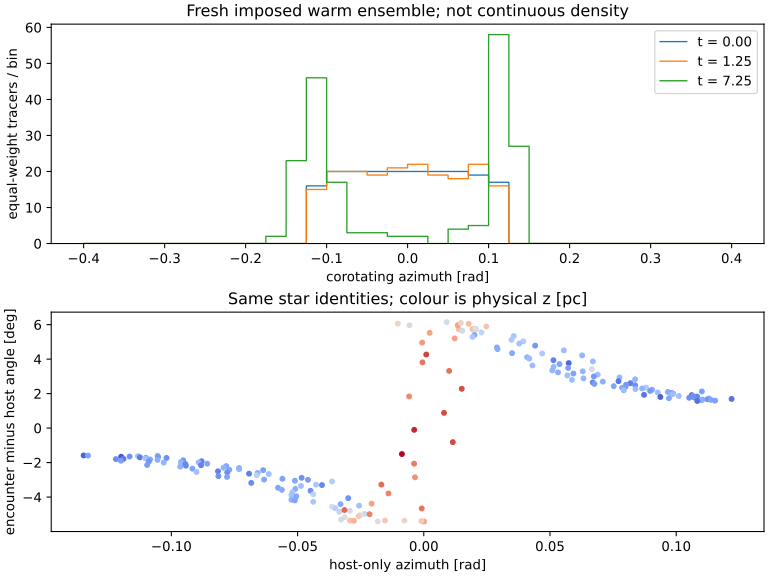
Reading: Sandbox Physics standalone stellar-stream scientific reader v1
Optionally acquire the actual fixed inputs
The optional command fetches exactly one fixed author ZIP, one official coordinate source and its MIT licence: 737348 response-body bytes in total. It verifies complete lengths and SHA values and stops on failure without a mirror retry. Alternatively, explicitly name an existing verified input directory; that is reuse, not fresh acquisition.
Original files, observed projection rows, fitted tracks and real-data plots remain in the reader’s private output. Public access and archive-level licensing do not automatically replace upstream Gaia conditions, so those rows and figures are excluded from the public package.
python -B optional_reader.py --acquire --output /absolute/new-private-pathReading: Valluri et al. (2025), GD-1 Stellar Stream and Cocoon in the DESI Early Data Release, arXiv:2407.06336v2 · Gala v1.12.0: fixed official GD1Koposov10 coordinate source · Sandbox Physics standalone stellar-stream scientific reader v1
Check the observer, then compute genuine C trajectories
The sequence checks the literal official matrix, map directions, solar velocity and proper-motion units before integrating one hundred million years backward and forward with the actual loaded galpy C path. Positive and negative circular motion, independent Cartesian integration and invariants must pass before saved known-truth recovery.
The fifteen-kiloparsec galpy length scale is an integration unit. The observer transformation separately fixes the Sun–Galactic-centre distance at 8.122 kiloparsecs and uses the source solar velocity explicitly listed in the code. Integration units and observer position serve different conversions.
The fit varies five conditional anchor quantities: stream latitude, distance, two corrected proper motions and heliocentric radial velocity. The spherical logarithmic host is fixed. The maximal monotonic-longitude branch containing the anchor must cover all source longitudes; it cannot splice in another orbital passage or extrapolate.
Earlier native coordinate-consistency checks remain failed. The method uses the verified source-defined map rather than empirically adjusting a rotation. The undocumented upstream differences remain a separate source question; the internal tests cover the explicitly defined transformation.
Reading: Gala v1.12.0: fixed official GD1Koposov10 coordinate source · Sandbox Physics standalone stellar-stream scientific reader v1
Keep all three starts, not just an attractive curve
All three predetermined starts are retained. The second never supplies complete longitude coverage and has no accepted track; it fails without a restart. The first exhausts 400 objective calls without convergence. The third reports success quickly but has a much worse loss.
The baseline is chosen by training loss alone. Two predetermined relative-weight scenarios start from that same candidate, without consulting held-out scores. Every accepted final track still needs independent whole-state, invariant and doubled saved-sampling checks.
The baseline held-out loss is about 0.608, worse than 0.445 for the same-fold cubic. Its two proper-motion held-out RMS residuals are approximately 0.218 and 0.362 milliarcseconds per year. Changing the positional weight changes the result; total losses under different weight definitions are not directly comparable.
Reading: Sandbox Physics standalone stellar-stream scientific reader v1
A successful replay can conclude that the model is inadequate
Read external clocks, actual return codes, objective-call counts and refusal reasons. A successful replay means those computations really ran again. It does not make the real orbit fit good enough to infer a Galactic potential or dark matter. There is no complete covariance, membership-selection likelihood or stream-release model here, and no confidence interval is claimed.
A useful next question is whether a release history improves cross-stream proper motion, or whether host changes trade against distance and solar correction. Those require new models and validation. Relaxing a numerical gate or removing inconvenient points is not a substitute.
Reading: Sandbox Physics standalone stellar-stream scientific reader v1 · Valluri et al. (2025), GD-1 Stellar Stream and Cocoon in the DESI Early Data Release, arXiv:2407.06336v2