A moving bubble wall turns vacuum energy into heat and bulk motion of the plasma. How much becomes motion depends on the transition strength α and on whether the wall is slower or faster than sound. For α=0.2 and ξw=0.9 the single-bubble efficiency is κ=0.274, and the template keeps a kinetic-energy fraction K=0.0274.
Strength and the bag model
Treat the plasma as a relativistic gas whose pressure is one third of its energy density, so the sound speed is cs=1/3≈0.577. In the bag model the false vacuum carries an extra constant energy density ϵ that the broken phase does not. The strength of the transition compares it with the radiation energy density before the wall, α=ϵ/(a+T+4), up to the constant that defines radiation energy.
The wall moves at speed ξw through the plasma at rest far away. Because nothing else sets a scale, the flow around a single expanding bubble depends only on ξ=r/t: it is self-similar. That is why one profile, solved once, describes the bubble at every time until it meets others.
A wall slower than sound is a deflagration. It pushes the plasma ahead of it, and a shock front runs out in front at slightly more than the sound speed. Between the shock and the wall the plasma moves outwards.
A wall faster than a limiting speed, the Jouguet speed ξJ, is a detonation. The plasma ahead is untouched; it is hit by the wall and dragged along behind it, where a rarefaction wave lets it slow down again by the time ξ=cs is reached.
Between cs and ξJ the solution is a hybrid with both a shock in front and a rarefaction behind. For α=0.2 the Jouguet speed is 0.828, so a wall at 0.9 is a detonation; for α=0.01 it is already 0.653.
ξJ(α)=1+α2α/3+α2+1/3
At α→0 this tends to cs. Larger strengths push the boundary towards the speed of light.
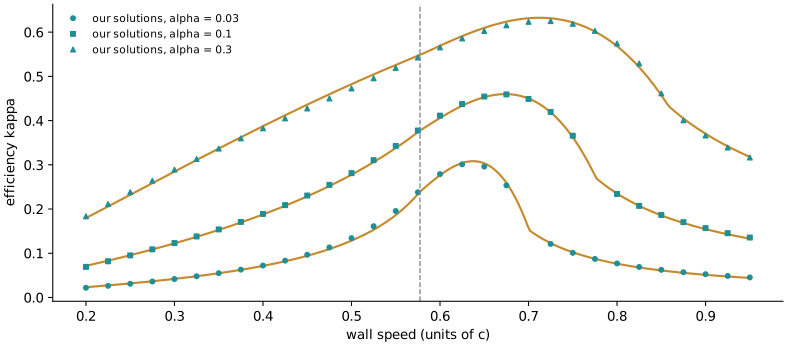
The efficiency κ is the fraction of the released vacuum energy that ends up in bulk kinetic energy of one bubble's flow. It is an integral of wv2γ2ξ2 over the self-similar profile, with enthalpy w, fluid speed v and Lorentz factor γ. Espinosa, Konstandin, No and Servant solved the profiles in 2010 and gave fits that they state agree with the solutions to better than 15 percent.
The fluid then carries a fraction of the total energy density. The LISA template of 2024 multiplies it by 0.6, a factor taken from many-bubble simulations in which the bulk motion is smaller than for isolated bubbles.
Worked example. For α=0.2 and ξw=0.9, the fit gives κ=0.2742. Our own profile solution gives 0.2740. Then K=0.6×0.2742×0.2/1.2=0.0274. For the slow-wall benchmark, α=0.1 and ξw=0.4, the fit gives 0.1877, our solution 0.1890, and K=0.0102.
K≃0.61+ακα
The 0.6 is the many-bubble correction adopted in arXiv:2403.03723v2. The 2020 LISA review, arXiv:1910.13125v2, wrote K=κα/(1+α) without it, so the same α and ξw give a different K in the two papers.
We integrated the self-similar fluid equations ourselves, with the junction conditions at the wall and at the shock, on a grid of six strengths from 0.01 to 0.5 and wall speeds from 0.2 to 0.95. Away from the Jouguet speed, the largest relative difference from the published fits is 7.4 percent, at α=0.01 and ξw=0.2.
Two kinds of point have no profile. Within 0.01 of the Jouguet speed our shooting method does not converge, and we leave those points out instead of plotting a fit there. For slow walls and strong transitions no deflagration exists at all: at ξw=0.4 the largest strength with a solution is α=0.590, and at ξw=0.2 it is 0.396. The Lab refuses to draw a spectrum above that bound.
The sound-shell thickness also comes from the profile: the template uses ξshell=∣ξw−cs∣, which holds for subsonic deflagrations and for detonations. Hybrids have thinner shells and no calibrated shell rule, so the Lab switches the template off, with a one-line notice, in the interval from cs−0.05 up to ξJ.
Efficiency κ for α=0.03, 0.1 and 0.3. Lines are the published fits of Espinosa et al. (2010); points are our own bag-model profile solutions. The dashed line marks the sound speed cs=1/3. Points are missing where our shooting does not converge near the Jouguet speed. Open the full figure
Is a wall at ξw=0.7 a detonation for α=0.05? For α=0.01?
Read the explanation
Compute ξJ: 0.730 for α=0.05 and 0.653 for α=0.01. The wall at 0.7 is a hybrid in the first case and a detonation in the second. The same wall speed changes type because a stronger transition needs a faster wall to leave the plasma ahead undisturbed.
Compute K for α=0.1, ξw=0.9, using κ=0.1545. How does it compare with the slow-wall case at the same strength?
Read the explanation
K=0.6×0.1545×0.1/1.1=0.00843, a little lower than 0.0102 at ξw=0.4. Fast detonations are not automatically more efficient: much of the energy heats the plasma behind the wall. Efficiency peaks for walls near the Jouguet speed.
Why can the Lab not simply use the fit for α=0.5 and ξw=0.25?
Read the explanation
The fit returns a number, but no steady deflagration exists there in the bag model; our solver finds the bound at α=0.429 for ξw=0.25. A number without a physical flow would be misleading, so the Lab shows a notice and no spectrum.
Read in the arXiv v2 LaTeX source: abstract and introduction, section 2.2.1 (sound-wave double broken power law, amplitude, mean bubble separation and redshift factors), section 3 and appendix A (two-parameter LISA noise and response) and the opening of section 5 on reconstruction. The noise equation prints the optical-metrology corner as 2e-3 mHz; our materials use 2 mHz and report both results. Figure 2 was read from its caption only.
Read the LaTeX source in two places: the sound-wave signal section (signal.tex, about lines 180 to 260) and the definition of the root-mean-square fluid velocity and kinetic-energy fraction (prelim.tex, lines 171 to 182). Used for the earlier shock-time definition only.
Read the fluid equations for a single self-similar bubble, the deflagration, hybrid and detonation profiles, and the appendix-B efficiency fits with their stated precision of better than 15 percent. Our own profile solutions in the bag model check the fits independently.
Our script, three fixed benchmarks, four failure cases and the expected output. It evaluates the published parametric template, the efficiency fits and the noise model; it does not solve the Einstein or fluid equations and contains no browser Engine code, paper text or LISA data.