Why shells and tails change near the neutron drip line
Sandbox Physics ·
Adding neutrons changes the environment experienced by later neutrons. Orbital energies move, and a wave close to the escape threshold can spread far beyond the core. A shell diagram copied unchanged from a stable nucleus can miss both effects.
An added neutron changes the next neutron’s environment
Choose an orbital a to follow and add neutrons to orbital b. Average the interaction of a pair over its spatial orientations. The resulting monopole matrix element Vab has units of energy; a negative value represents average attraction.
In the simplest frozen-orbital approximation, each added occupation of b shifts the energy of a by Vab. The sign gives a useful direction of change. A quantitative calculation must also solve for changing orbitals, correlations and occupations.
For a worked illustrative example, set ϵa(0)=1.2MeV and average two-body attraction −0.4MeV. Six added neutrons move the orbital to −1.2MeV. An additional repulsive contribution +0.25MeV per occupation instead leaves it at +0.3MeV. These assigned numbers show how a modest pair contribution accumulates.
ϵa(nb)≃ϵa(0)+nbVab
This is a frozen-orbital teaching model with one fixed threshold. Its sign alone does not determine the binding of an actual isotope.
Open Otsuka and colleagues’ 2010 paper, version 3. Begin with Figure 2, then return to Eq. 1. The figure plots effective single-particle energies defined relative to an oxygen-16 core against neutron number. Equation 1 defines the orientation average that connects interaction matrix elements to occupation shifts.
The paper compares specified oxygen-isotope calculations with two-nucleon interactions and with added three-nucleon contributions. Repulsion from the three-body mechanism changes the orbital evolution and helps explain why the oxygen drip line occurs earlier than the two-body-only calculations predict. Figure 3 explains the mechanism; Figure 4 connects the discussion to ground-state energies.
Our reading node preserves the paper version, figures and assumptions. The offline exercise recalculates the illustrative occupation shift above. It does not solve the paper’s many-body Hamiltonian. Repeating that calculation requires fixed nuclear forces, truncations, basis spaces, effective interactions and numerical error studies in an offline many-body program.
Read the changing thresholds from evaluated masses
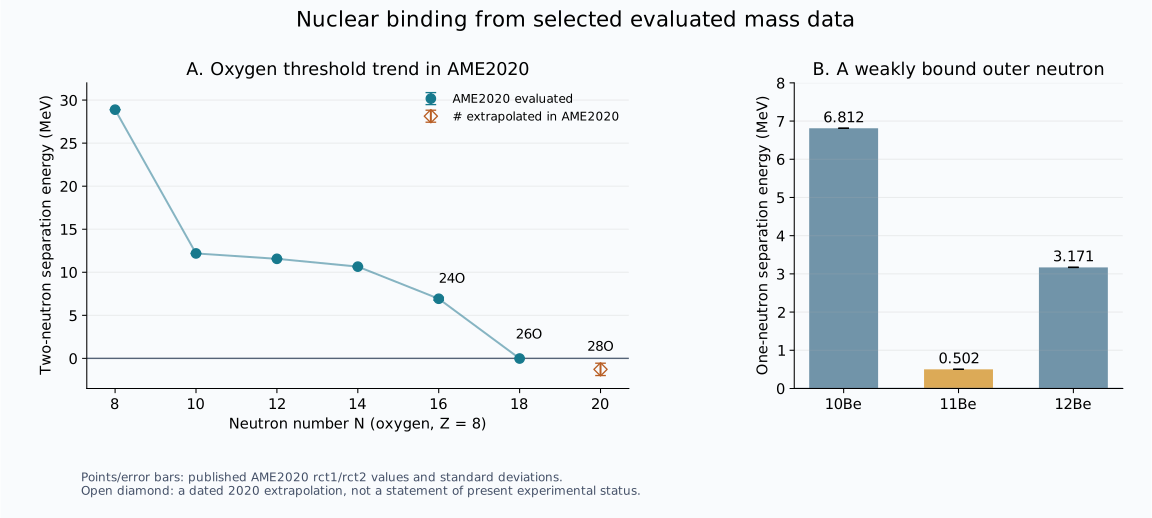
In AME2020, the two-neutron separation energy falls from 6.925MeV in oxygen-24 to −0.018MeV in oxygen-26. Their difference, 6.943MeV, is an empirical two-neutron shell-gap indicator. Pairing, correlations and continuum effects contribute to it; the difference alone cannot identify one term in the nuclear force.
Oxygen-26 still has positive one-neutron separation energy, about 0.739MeV. Its one-neutron daughter oxygen-25 is already unbound. The negative two-neutron value shows why all allowed removal channels matter when judging nuclear stability.
Removing a neutron from beryllium-11 costs only 0.502MeV, compared with 6.812MeV for beryllium-10. That is mass evidence for weak binding. It supplies no exterior probability by itself; the radial decay calculation below connects the small energy to a spatial scale.
Error bars use the published AME separation-table uncertainties. The mass evaluation correlates its inputs, so independent-error quadrature would change the statistical assumptions. Extrapolation markers preserve the status of AME2020 and do not assert present-day experimental knowledge.
Calculated from frozen AME2020 mass excesses and checked against its published separation tables. Error bars use the published marginal errors. Open estimates show the status in that evaluation. Select the figure to enlarge it. Values and provenance
Return to a zero-angular-momentum neutron-plus-core model. Far outside the nuclear interaction, a negative-energy radial wave must decay exponentially. Its decay constant is κ=Sn/C. Weak binding therefore produces a small decay constant and a long tail.
Using the same illustrative C=20.72125MeVfm2, decreasing separation energy from 5MeV to 0.5MeV increases the amplitude decay length 1/κ from 2.04fm to 6.44fm. The core radius need not increase with it. The figure fixes equal amplitude at the boundary to isolate the exterior decay.
A decay length is not the nuclear root-mean-square radius. A full radius also needs the interior wave, the probability carried outside and the core size. Evidence for a neutron halo combines weak binding with extended structure and angular-momentum information. A centrifugal barrier changes the threshold behavior of higher angular momentum.
u(R)u(r)=e−κ(r−R),κ=CSn,r>R
The curve is an exterior radial-amplitude ratio. It assigns no probability to the exterior relative to the complete state.
⟨(r−R)2⟩exterior=2κ21
This moment holds after normalizing the pure exponential probability on the exterior alone. It is a conditional exterior moment.
5 MeV binding
0.5 MeV binding
Calculated exterior amplitude ratios for the stated infinite-mass-core example. Equal boundary amplitudes isolate the decay length; the curves are not complete normalized nuclear densities.
Once a channel opens, a neutron can escape to infinity and a discrete normalizable bound state disappears. A centrifugal barrier can still hold the wave temporarily, producing a resonance with a finite lifetime and width. One of the oxygen-17 levels in Chapter 3 is such a neutron-unbound resonance.
Near threshold, structure and reactions become closely connected. Energies locate a state relative to escape; scattering and capture probe its continuum behavior. Level energies, widths and reaction cross sections must share a threshold and unit convention. Our well and pairing examples isolate mechanisms. Quantitative predictions require an effective or many-body method suited to the relevant continuum.
Predict which extra quantity a table needs for an unbound resonance.
Choose oxygen-17 and inspect the width and residual of the 5.0848 MeV state.
Explain why fitting an energy alone does not determine a lifetime or an exterior tail.
Exercises and explanations
At fixed reduced mass, what happens to the amplitude decay length if binding falls to one quarter of its value?
Read the explanation
The length 1/κ=C/Sn doubles. This describes the exterior zero-angular-momentum tail; a full radius still needs normalization and interior information.
An orbital starts at 0.8MeV and shifts by −0.1MeV per occupation. What is its energy after four additions? Include a second contribution +0.15MeV per occupation.
Read the explanation
With only the first contribution the energy is 0.4MeV. Including both gives 1.0MeV. These assigned interactions give frozen-orbital energies. An isotope separation energy requires the complete ground-state energies of neighboring nuclei.
Sources and reproduced scope
Evaluated level energies and published reaction measurements retain their source versions and uncertainties. Model curves, schematic figures and synthetic scattering records are identified separately. The offline benchmark files state which calculations have been reproduced.
Frozen March 2021 unrounded oxygen and beryllium entries, independently parsed from the mass table. Published marginal separation errors are retained. Hash marks describe extrapolation in that dated evaluation.
Frozen March 3, 2021 mass-table format, neutron and hydrogen/deuterium rows. Mass excess and binding per nucleon are in keV; # marks extrapolated values. The course uses a three-row numerical excerpt with its original uncertainties.
Radial equation, regularity at the origin and the finite spherical well. Our bound-state threshold and tail curves are derived calculations for the stated infinite-core-mass example.
Selected oxygen-17 levels, spin/parity, energy errors and the width of the neutron-unbound 5.0848 MeV resonance. The numerical excerpt is separate from the fitted single-neutron model.
Complex-potential description of elastic-channel loss. The browser implements a sharply bounded complex square well, not a global fitted optical potential.
Version 3, June 19, 2010; Eq. 1 and Figs. 2–4. The course reads the monopole mechanism and derives an illustrative occupation shift. It does not reproduce the many-body calculation or digitize its curves.
Keep reading
What this page links to directly
You are hereWhy shells and tails change near the neutron drip line