Choose the direction before writing the force
Let be cylindrical radius in the disk plane, increasing outwards. Write the gravitational potential as . The outward acceleration is . It is convenient to define the signed inward acceleration ; a positive value means a pull towards the centre.
A circular tracer has constant speed and a continually changing velocity direction. Newton’s second law equates its inward force to its mass times the circular acceleration. The tracer’s mass cancels. The remaining relation works for a disk, a sphere or their combined field when a circular orbit in an axisymmetric potential is a suitable approximation.
Reading: Independent saved-observation rotation-curve calculation
Spherical shells reduce the problem to interior mass
Divide a spherically symmetric body into concentric thin shells. A complete shell outside the test point exerts zero net force there. Every interior shell acts, at that point, as though its mass were concentrated at the centre. Adding those interior shells gives a force determined by enclosed mass.
For volume density , a shell at radius with thickness has volume approximately . Multiplying by density gives the shell mass. The integral adds these shells from the centre to . This is why the upper integration limit and the spherical geometry enter together.
Reading: Spherical shell theorem foundation Lab · Independent saved-observation rotation-curve calculation
Worked example: weigh a spherical flat-speed interval
Suppose the circular speed is from to , and explicitly assume a spherical gravitating source. Use .
Squaring the speed gives . At the inner radius, . Divide by to obtain . Doubling the radius at unchanged speed doubles the enclosed mass to .
This inference covers the specified finite interval. It does not make a measurement of an infinite halo or determine the galaxy’s total mass. Extending the result beyond the observed radii requires further observations or an additional model assumption.
For an ideal continuously flat spherical curve, differentiate and divide by the shell-area factor. This gives . An inverse-square density profile adds the same mass in each equal-width radial shell, explaining the linear growth of enclosed mass.
Reading: Independent saved-observation rotation-curve calculation
A disk also feels material beyond the test radius
Flatten the mass into a disk. An outer ring has a nearer side and a farther side, and their attractions no longer cancel as a spherical shell’s do. An exterior ring can supply an outward radial component. The disk calculation must add rings on both sides of the chosen radius.
A surface density describes mass per disk area; it differs from volume density and can be measured in . An exponential disk has , where is the radial scale over which surface density falls by a natural exponential factor.
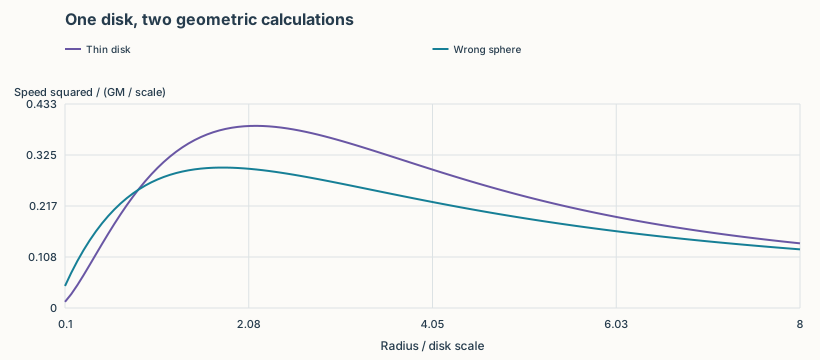
Integrate the Newtonian potential of those rings and then differentiate with respect to the test radius to obtain the disk-plane force. The next chapter supplies a convenient special-function expression. We can already test the geometrical shortcut by applying it to exactly the same disk.

Reading: Independent saved-observation rotation-curve calculation · Lelli, McGaugh & Schombert (2016), SPARC, AJ152,157
A numerical counterexample with one fixed disk
Let the disk have total mass and evaluate it at . The actual razor-thin disk gives . Inserting only the interior disk mass into the spherical formula gives . Its speed-squared estimate is about 24.2 percent too low.
The two calculations use the same exponential mass distribution. Their difference comes from gravitational geometry. The radius label alone cannot decide which enclosed-mass relation is valid.
This test concerns an ideal thin disk. Imported SPARC stellar components retain their native finite-thickness disk calculation. Accurately evaluating the thin-disk benchmark checks the mathematics; it does not reconstruct a native finite-thickness force field.
Reading: Independent saved-observation rotation-curve calculation