The outer gas keeps its speed through a larger turn
Picture a path from the bright centre of a disk galaxy towards its faint outskirts. Astronomers measure shifts in gas spectral lines to estimate motion along our line of sight. With a model of the galaxy’s orientation, they infer how fast the gas travels around the centre. A rotation curve plots that circular speed against radius. Its horizontal axis is position, not time.
Many galaxies have an outer interval over which the speed changes little. This is the flat part of the curve. The outer gas still takes longer to finish a circuit: it has a larger circumference to travel at about the same speed. Equal orbital speed does not mean equal angular speed.
The Solar System encourages a different expectation. Planets farther from the Sun generally travel more slowly, because almost all the mass is concentrated in the Sun. A galaxy spreads its stars and gas across a large region. Its gravitational pull depends on that distribution, together with any additional extended mass.
Reading: Lelli, McGaugh & Schombert (2016), SPARC, AJ152,157
Speed gives the acceleration needed to bend the path
A particle moving around a circle continually changes the direction of its velocity. It needs an acceleration towards the centre even when its speed stays constant. Double the speed at the same radius and the required acceleration becomes four times larger. Keep the speed and double the radius, and it becomes half as large.
The flat part of a rotation curve follows the second comparison. Gravity remains important at large radius, and declines more slowly than the distant pull of a concentrated mass. That statement concerns the total acceleration required by the motion. We can make it before deciding which component supplies the acceleration.
Reading: Independent saved-observation rotation-curve calculation
Light locates stars; stellar populations help weigh them
An infrared image maps stellar light. Converting light to stellar mass requires a mass-to-light ratio: the amount of mass associated with a unit of luminosity. Stars of different ages and types can give different ratios. A heavier stellar disk supplies more of the gravity needed by a given rotation curve.
Gas supplies gravity too, and its distribution is estimated from other observations. In a Newtonian mass model, an extended dark halo can supply the force left after the stellar and gas contributions. A halo describes a spatial mass distribution. Identifying its particles requires further evidence beyond the fitted mass distribution.

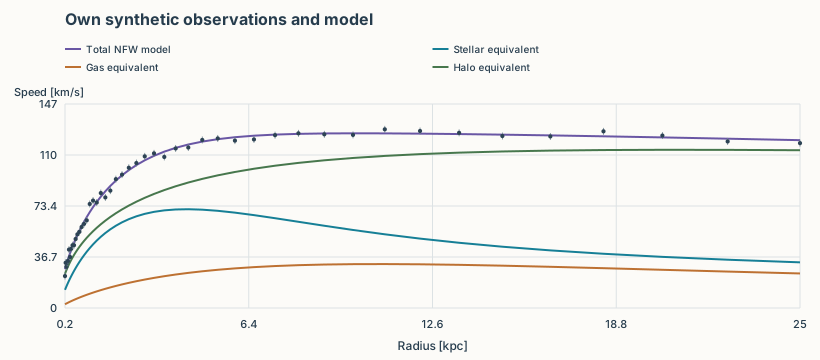
Reading: Lelli, McGaugh & Schombert (2016), SPARC, AJ152,157
Disk and halo can compensate for each other
A heavier stellar disk may be paired with a weaker halo. A lighter disk may need a stronger halo. Across a limited range of radii, different allocations can produce similar total speeds. This compensation is the disk–halo degeneracy. The total radial pull can be clearer than the division of that pull among components.
Geometry matters as well. A spherical shell has cancellations that a disk does not share. Material outside a chosen disk radius can still pull on an interior test particle. Using a spherical mass formula for a disk can therefore introduce a geometrical error into the inferred enclosed mass.
Distance and orientation move the inference coherently. At a larger distance, the same angle on the sky spans a larger physical radius. A more face-on disk needs a larger circular speed to give the same line-of-sight motion. Better geometry and independent stellar-mass estimates can narrow the room available for compensating mass models.
Reading: Independent saved-observation rotation-curve calculation · Lelli, McGaugh & Schombert (2016), SPARC, AJ152,157
A force map becomes stronger with other observations
A rotation curve gives a radial map of the required force. Stellar spectra, gas measurements and gravitational lensing can add information from different directions. The question then becomes concrete: which mass distributions explain these measurements together, and which require unusual stellar masses or viewing parameters? Comparing those conditions brings us closer to an answer than choosing a curve by appearance alone.
Reading: Smith et al., Dark Matter and MOND successes and degeneracies, arXiv:2610.33157v1