Sandbox Physics
Galactic bars, resonances and stellar migration

Galactic bar orbits · L2

Torque and energy in a rotating bar

Open the rotating-bar Lab

A rotating bar changes a star's angular momentum by exerting a tangential force. Its changing gravitational potential also exchanges energy with the star. For one rigid pattern of constant strength and speed, those exchanges are tied together by a conserved Jacobi integral.

Specify the gravitational field

Work in the dimensionless units R0=v0=1R_0=v_0=1. The background potential is ln⁡R\ln R. Add a two-fold bar with dimensionless amplitude AA, fixed radius Rb=0.5R_b=0.5 and phase θb\theta_b. A positive pattern speed rotates counterclockwise, with θ˙b=Ωp\dot\theta_b=\Omega_p.

The outer radial shape falls as the inverse cube. The inner expression joins it with a continuous value and first derivative at RbR_b; its second derivative jumps. The interactive trajectories use only R>RbR>R_b. This is a specified force on massless tracers; their positions do not rebuild the gravitational field.

Φ(R,ϕ,t)=ln⁡R+A(t)f(R)cos⁡[2(ϕ−θb(t))],f(R)={(R/Rb)3−2,R<Rb,−(Rb/R)3,R≥Rb.\Phi(R,\phi,t)=\ln R+A(t)f(R)\cos[2(\phi-\theta_b(t))],\qquad f(R)=\begin{cases}(R/R_b)^3-2,&R<R_b,\\-(R_b/R)^3,&R\ge R_b.\end{cases}
Potential has units of speed squared before nondimensionalisation. The amplitude specifies a quadrupole potential, not a fitted bar mass or a self-consistent density.

Reading: Dehnen (1999v1/2000), The Effect of the Outer Lindblad Resonance of the Galactic Bar on the Local Stellar Velocity Distribution · Sandbox Physics independent galactic-bar scientific reader v1

The angular derivative gives the torque

Specific angular momentum is Lz=xvy−yvx=R2ϕ˙L_z=xv_y-yv_x=R^2\dot\phi. A radial force has no moment about the centre. The tangential force is Fϕ=−(1/R)∂Φ/∂ϕF_\phi=-(1/R)\partial\Phi/\partial\phi; multiplying by its lever arm RR gives the specific torque τz\tau_z.

Differentiating the cosine produces a sine. Ahead of and behind a bar axis, its sign changes. A star therefore gains angular momentum during part of an encounter and loses it during another part. The net change requires the force along the complete trajectory.

L˙z=τz=−∂Φ∂ϕ=2Af(R)sin⁡[2(ϕ−θb)]\dot L_z=\tau_z=-\frac{\partial\Phi}{\partial\phi}=2Af(R)\sin[2(\phi-\theta_b)]
The sign follows the stated counterclockwise convention. Specific torque has units of speed squared.

Reading: Sellwood & Binney (2002), Radial mixing in galactic discs, astro-ph/0203510v2

A changing potential does work

The star's specific energy is E=∣v∣2/2+ΦE=|\boldsymbol v|^2/2+\Phi. Differentiating along its motion produces a kinetic term v⋅v˙\boldsymbol v\cdot\dot{\boldsymbol v} and a spatial-potential term v⋅∇Φ\boldsymbol v\cdot\nabla\Phi. Newton's equation makes those cancel. The remaining rate is the explicit time derivative of the potential.

When only the pattern rotates, that derivative is Ωpτz\Omega_p\tau_z. Consequently a gain ΔLz=0.05\Delta L_z=0.05 at fixed Ωp=1.2\Omega_p=1.2 requires ΔE=0.06\Delta E=0.06. The star's energy itself is not constant.

The conserved combination is the Jacobi integral. It is an excellent diagnostic only after its physical conditions are established.

E˙=∂Φ∂t=Ωpτz,EJ=E−ΩpLz,ΔE=ΩpΔLz\dot E=\frac{\partial\Phi}{\partial t}=\Omega_p\tau_z,\qquad E_J=E-\Omega_pL_z,\qquad \Delta E=\Omega_p\Delta L_z
These last two relations assume one rigid pattern with constant amplitude and constant pattern speed.

Reading: Sellwood & Binney (2002), Radial mixing in galactic discs, astro-ph/0203510v2

Write the conserved quantity in bar coordinates

A rotating observer measures a velocity different from the inertial velocity. At a fixed point the two differ by Ωp×r\boldsymbol\Omega_p\times\boldsymbol r. Substitute that velocity relation into the inertial energy and subtract ΩpLz\Omega_pL_z. The cross term cancels, leaving rotating kinetic energy plus an effective potential.

The extra negative centrifugal term comes from changing frames; it is not a new gravitational mass. At fixed Jacobi value, a point where that value is below the effective potential has no real rotating speed available. This gives a useful allowed-region test, although it does not determine the trajectory inside an allowed region.

The Coriolis force also appears in the rotating equation of motion. It turns velocity and does no work because it is perpendicular to that velocity. Keeping this distinction prevents a rotating orbit plot from being mistaken for an inertial force diagram.

EJ=u2+v22+Φeff,Φeff=Φ−Ωp2R22E_J=\frac{u^2+v^2}{2}+\Phi_{\rm eff},\qquad \Phi_{\rm eff}=\Phi-\frac{\Omega_p^2R^2}{2}
This form assumes a rigid frame of constant angular speed. The symbols u,vu,v denote rotating coordinate velocities, not canonical momenta.

Reading: Sellwood & Binney (2002), Radial mixing in galactic discs, astro-ph/0203510v2 · Sandbox Physics independent galactic-bar scientific reader v1

Growth and slowdown add explicit terms

If the amplitude grows, ∂Φ/∂t\partial\Phi/\partial t contains A˙fcos⁡[2(ϕ−θb)]\dot A f\cos[2(\phi-\theta_b)]. If the pattern speed also changes, differentiating E−ΩpLzE-\Omega_pL_z contributes −Ω˙pLz-\dot\Omega_p L_z. Both terms have to be included.

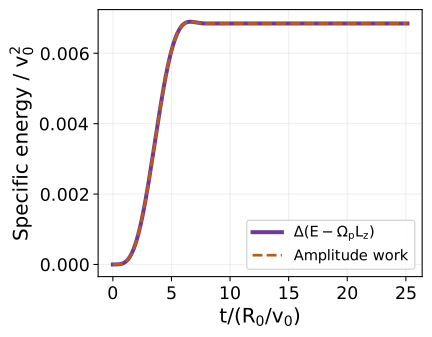
The reader's controlled growth example raises AA smoothly from zero to 0.040.04 over eight time units, at constant Ωp=1\Omega_p=1. Its largest Jacobi change among ten test states is about 0.0068970.006897. The independent time integral of the amplitude work agrees with that change to about 2.6×10−122.6\times10^{-12}. Demanding constant Jacobi during this growth would reject a correct solution.

The interaction changes physical parameters by preparing a new history from the same release. Dragging its pattern-speed control is not a simulation of a bar slowing down. A slowdown calculation must specify the entire time-dependent phase and include the corresponding work.
ddt(E−ΩpLz)=A˙f(R)cos⁡[2(ϕ−θb)]−Ω˙pLz\frac{d}{dt}(E-\Omega_pL_z)=\dot A f(R)\cos[2(\phi-\theta_b)]-\dot\Omega_p L_z
The expression assumes the same prescribed field and no additional time-dependent background. In a live galaxy, the bar and halo exchange angular momentum dynamically.
New independent integration comparing the changing Jacobi quantity with integrated amplitude work.
Own prescribed-growth calculation from the saved ten-star reference. Purple gives the change in the Jacobi quantity; the dashed curve integrates the explicit amplitude work.

Reading: Sandbox Physics independent galactic-bar scientific reader v1 · Chiba, Fujii, Baba, Dubinski & Schönrich (2026), Tree-ring structure of Galactic bar resonance in N-body simulations, arXiv:2604.01294v1

Angular momentum change can move the guiding radius

In an axisymmetric flat-speed reference, a circular orbit has Lz=Rgv0L_z=R_gv_0, so Rg=Lz/v0R_g=L_z/v_0 defines a guiding radius. This is a reference label, not the current distance to the centre.

For a near-circular orbit, write energy as the circular-orbit energy plus radial-oscillation energy. The slope of circular energy against angular momentum is dEc/dLz=ΩdE_c/dL_z=\Omega. Combining it with the steady-pattern exchange gives Δ(E−Ec)≃(Ωp−Ω)ΔLz\Delta(E-E_c)\simeq(\Omega_p-\Omega)\Delta L_z to first order.

At corotation that first-order radial-heating cost vanishes. A star can change its guiding radius without a comparably large increase in radial motion. Away from corotation, heating generally accompanies the exchange. Temporary waves can leave a lasting change when they fade; a permanently present wave can allow a later return.

dE=Ω dLz+κ dJR,ΔJR≃Ωp−ΩκΔLzdE=\Omega\,dL_z+\kappa\,dJ_R,\qquad \Delta J_R\simeq\frac{\Omega_p-\Omega}{\kappa}\Delta L_z
Here radial action is the oscillation energy divided by its frequency in the near-circular limit. The steady-pattern relation is a local leading-order argument; growing or fading waves require the time-dependent treatment.

Reading: Sellwood & Binney (2002), Radial mixing in galactic discs, astro-ph/0203510v2

Exercises and explanations

  1. A rigid bar has Ωp=0.8\Omega_p=0.8 and gives a star ΔLz=−0.03\Delta L_z=-0.03. What is its energy change?

    Read the explanation

    It is ΔE=−0.024\Delta E=-0.024 in units of v02v_0^2. The negative torque removes angular momentum and the rotating field removes energy in the same fixed proportion.

  2. A growth calculation changes Jacobi but matches the integral of explicit amplitude work. Is that change automatically an integration error?

    Read the explanation

    No. Jacobi conservation required a time-independent potential in the rotating frame. Amplitude growth breaks that condition; the corrected work relation is the appropriate diagnostic.

Try the prediction

Follow the torque over a full encounter

  1. Keep the pattern speed and strength fixed, select a star, and compare its angular-momentum change at several replay times.
  2. Predict the sign of its energy change using the fixed pattern speed.
  3. Use the reader's growth figure to explain why this conserved combination cannot be carried across arbitrary physical-parameter changes.

Sources and calculation scope

  1. Dehnen (1999v1/2000), The Effect of the Outer Lindblad Resonance of the Galactic Bar on the Local Stellar Velocity Distribution

    Fixed 14-page astro-ph/9911161v1, all text read in parameter preflight; equation 3, section 3 and original orbital figures. The own model uses a fixed bar radius 0.5 and counterclockwise convention. The paper's historical Milky Way inference is not treated as a current measurement.

  2. Sellwood & Binney (2002), Radial mixing in galactic discs, astro-ph/0203510v2

    Fixed 13-page v2, complete original read; section 2 specific energy/action exchange and sections 3–4 transient self-gravitating waves. The paper's live-disk simulations are distinct from our prescribed external-bar release.

  3. Chiba, Fujii, Baba, Dubinski & Schönrich (2026), Tree-ring structure of Galactic bar resonance in N-body simulations, arXiv:2604.01294v1

    Fixed 1 April 2026 v1, PDF draft dated 3 April; complete 21 pages including appendices/references actually read. Key printed pages 3/5/6/7/8/10/13/15/18 rendered and viewed. A/B live/static control, C/D satellite tests, equations 5–11 and appendices A–D; no original PDF/figure is redistributed.

  4. Sandbox Physics independent galactic-bar scientific reader v1

    Own zero-network Python integration and saved-record analysis: one full 256-tracer population, ten independent DOP853 controls, exact circle/epicycle, prescribed-growth work, six fresh periodic roots and three own synthetic figures. No App, completed orbit input, original paper or observed data.

FeedbackSomething broken, confusing, or missing on this page?Tell us
What kind of feedback?

Sent with this page’s address, its Lab ID, the site language and your device type. Please leave out personal details. Feedback is kept for up to 12 months.Privacy policy