An ordinary release does not solve a periodic orbit
The experiment releases tracers from eight rings, with sixteen azimuths per ring and two radial-velocity signs at each location. Every tracer has weight one over 256. In a cold release the two signs give the same initial state, leaving 128 distinct positions. This is a convenient sampling of a prescribed field, not an equilibrium distribution function.
We integrate the four inertial coordinates (x,y,vx,vy) over 8π time units. A kick changes velocity, a drift advances position, and a second kick completes one KDK step. Halving the step and comparing the entire history tests the trajectory, not just its final energy.
The fine record has 257 saved frames. The middle/fine difference divided by three is a second-order error estimate; it is conditional on the method being in its convergent range. Independent DOP853, a different high-order adaptive integration method, and exact limits give separate evidence. Every actual drift must remain on the admitted outer branch.
Reading: Sandbox Physics independent galactic-bar scientific reader v1
Use symmetry to ask a precise return question
Fix A=0.01, Ωp=1, Rb=0.5. In bar coordinates start at (x,y,u,v)=(a,0,0,w), where u,v are the rotating coordinate velocities. For these outside-corotation orbits, w is negative. At the first upward crossing of y=0 on the negative x side, ask whether u has returned to zero.
The return velocity is a function of w. A sign-changing bracket lets a root solver find the zero. Reflection symmetry then suggests a full period equal to twice that half-return time. We then integrate the full period and check all four coordinates to test the symmetric return.
At a=1.45 the new solution has w=−0.4483214884 and period 20.13125220. Its initial inertial tangential velocity is w+Ωpa≃1.001678512, not the negative rotating-frame value. The complete reference return residual is below 10−9.
Reading: Dehnen (1999v1/2000), The Effect of the Outer Lindblad Resonance of the Galactic Bar on the Local Stellar Velocity Distribution · Sandbox Physics independent galactic-bar scientific reader v1
The parents are almost circular
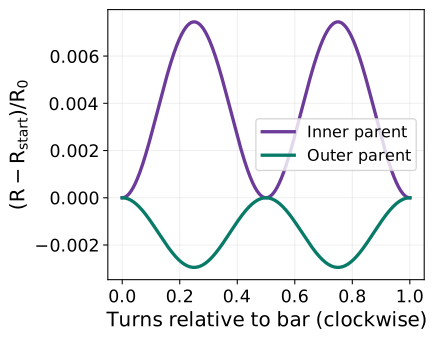
The reader freshly shoots three nearby parents at a=1.44,1.45,1.46 and three at a=1.89,1.90,1.91. The inner set extends slightly farther perpendicular to the bar; the outer set slightly farther parallel to it. Both sets are outside corotation and are separated by the circular outer Lindblad reference.
The departures from a circle are small. A separate radial-change plot makes that measurable response visible without deforming the physical orbit. These six solutions give local samples on two sides of the reference; they do not trace a connected branch through the resonance or justify assigning a standard family name.
Reading: Sandbox Physics independent galactic-bar scientific reader v1
A small displacement tests linear behaviour
First hold the Jacobi value fixed and remove a change that merely puts the star a little earlier or later on the same orbit. Ask whether the remaining tiny displacement grows on successive returns or oscillates locally. The latter behaviour in the reduced linear problem is called elliptic. To test a parent, displace its initial state slightly and follow the displacement for one parent period. At first order a matrix M maps the initial displacement to the final one. Its eigenvalues describe whether small disturbances grow from period to period or mainly rotate in phase.
Canonical variables are paired coordinates and momenta in which Hamilton's equations have their standard form. The flow preserves an oriented-area structure between these pairs, called the symplectic structure. Checking it tests a property of the linear mapping; the eigenvalues answer the separate question about linear growth. This is a technical geometric check in canonical coordinates; it requires more than volume preservation.
Variational equations come from expanding the original motion equations to first order in a small displacement. The reader independently compares a variational-equation calculation with positive and negative displaced integrations. It converts the rotating velocities to canonical momenta (px,py)=(u−Ωpy,v+Ωpx) before checking the Hamiltonian symplectic structure. Rotating velocities themselves are not canonical momenta.
For each of the two base parents, the nontrivial eigenvalue pair lies on the unit circle away from the real endpoints; the trivial multiplier pair expected at unity is checked separately. This is a linearly elliptic result on a fixed-Jacobi section after removing phase. Finite disturbances can behave differently. The four neighbouring parents have no inherited stability classification.
Reading: Sandbox Physics independent galactic-bar scientific reader v1
A changing radius can mean two different things
In an axisymmetric field, a star can swing inward and outward while Lz remains constant. Its guiding radius stays fixed. With a bar or spiral torque, Lz can change as well.
In the saved reader population, the selected example begins with reference guiding radius Rg=1 and ends with ΔLz≃−0.0596448. For v0=1, its final reference guiding radius is 0.9403552. That is an endpoint change within a continuously present bar; subsequent exchange may continue.
Sellwood and Binney's transient-spiral experiments provide the additional step needed for lasting migration. Near corotation, stars execute horseshoe-like changes relative to the wave. A persistent perturbation can carry them back. If the wave fades during the exchange, stars can retain changed guiding radii after it is gone. A succession of such events mixes birth radii through a disk.
Reading: Sellwood & Binney (2002), Radial mixing in galactic discs, astro-ph/0203510v2 · Sandbox Physics independent galactic-bar scientific reader v1
Let the history decide which claim is appropriate
A fixed external bar is useful for isolating the force, reference-frame changes and periodic returns. A growing or fading spiral requires a time-dependent history. A slowing live bar additionally exchanges angular momentum with its surrounding disk and halo.
In the 2026 frontier study, the moving corotation resonance carries some trapped stars outward and preserves part of their capture ordering. Its slow resonant angle librates. Our six periodic parents circulate around the bar in relative angle. Both involve resonances, but their phase-space questions and diagnostics are different.
Reading: Sellwood & Binney (2002), Radial mixing in galactic discs, astro-ph/0203510v2 · Chiba, Fujii, Baba, Dubinski & Schönrich (2026), Tree-ring structure of Galactic bar resonance in N-body simulations, arXiv:2604.01294v1