Sandbox Physics
Binary mass transfer and common envelopes

AC29 · L3

When mass transfer feeds its own overflow

A small mass loss eases or worsens overflow according to which changes faster: the donor radius or its Roche lobe. This comparison gives a local feedback direction. It supplies neither a transfer rate nor the final fate of a common envelope.

Write a small change in how fully the star fits

Remove a little mass from a donor close to its critical surface. Before declaring instability, ask whether its radius relative to the lobe radius increases or decreases. An expanding donor can ease overflow if the lobe expands still faster. The same stellar expansion inside a contracting lobe makes overflow worse.

ζ∗=dln⁡Rddln⁡Md,ζL=dln⁡RLdln⁡Md,dln⁡RdRL=(ζ∗−ζL)dln⁡Md\zeta_*={d\ln R_d\over d\ln M_d},\qquad\zeta_L={d\ln R_L\over d\ln M_d},\qquad d\ln{R_d\over R_L}=(\zeta_*-\zeta_L)d\ln M_d
Both responses must describe the same removal and angular-momentum prescription. The stellar response also names the adjustment timescale being considered.

Mass loss means dlnMd<0dln M_d<0. Thus zeta∗>zetaLzeta_*>zeta_L locally reduces overfill, while zeta∗<zetaLzeta_*<zeta_L increases it. Pause over this minus sign: a larger response exponent does not mean a larger radius after mass is lost.

Substitute RL=af(q)R_L=af(q) and use the preceding chapter’s ledgers.

ζL=2(bq−1)+(1−b)(2γ+1)q1+q+(1+bq)dln⁡fdln⁡q\zeta_L=2(bq-1)+(1-b)(2\gamma+1){q\over1+q}+(1+bq){d\ln f\over d\ln q}
The first terms describe orbital separation; the last describes lobe shape within that separation. Donor wind and accretor re-emission update the lever-arm factor with the current mass ratio.

Reading: Soberman, Phinney & van den Heuvel (1997), astro-ph/9703016v1

A star has more than one radius response

Rapid removal leaves little time to rebuild thermal equilibrium. An adiabatic response approximately preserves the entropy distribution of retained layers. Slower removal can instead be compared with thermally adjusted equilibrium structures. These exponents answer different questions about how much adjustment time the star receives.

A core-free, fully convective n=3/2n=3/2 polytrope gives RdproptoMd−1/3R_dpropto M_d^{-1/3} and therefore zetamad=−1/3zeta_{ m ad}=-1/3: losing mass expands it. This belongs to a specified model, not every giant with a core. Entropy stratification, core mass and evolutionary state change the response.

Another teaching choice uses zetamad=4zeta_{ m ad}=4 and zetameq=0.8zeta_{ m eq}=0.8. If the same lobe response lies between them, rapid loss reduces overfill while thermal adjustment tends to fill the lobe again. Avoiding immediate dynamical growth is different from maintaining long-term thermal equilibrium transfer. The elapsed times require additional stellar and transfer physics.

Reading: Soberman, Phinney & van den Heuvel (1997), astro-ph/9703016v1

An accurate radius fit can still reverse the sign

The calculation needs how the radius changes with mass ratio, not just the radius itself. A fit with sub-percent radius error does not inherit the same error bound for its derivative. Near equal stellar and lobe responses, a small derivative bias can reverse the feedback sign.

For conservative transfer with the core-free convective response, directly differentiating the critical three-dimensional volume puts local neutrality near q=0.630686q=0.630686. Differentiating Eggleton’s fit instead gives about 0.6339800.633980. Both are conditional local-model thresholds, not universal critical mass ratios for binaries.

Choose q=0.6323329q=0.6323329 between them, and remove one ten-thousandth of the initial donor mass. An independent rotated-angle finite-volume calculation increases relative overfill by about 3.45imes10−73.45 imes10^{-7}. Using the radius fit for the same removal decreases it by about 3.67imes10−73.67 imes10^{-7}. Keeping the failed fit makes the derivative issue visible; many successful examples far from neutrality would miss it.

A second retained example at equal masses with a stipulated zeta∗=0.460zeta_*=0.460 also reverses the sign. The interactive model therefore directly integrates and refines the volume derivative at each selected mass ratio. Numerical refinement and fit bias remain separate. Within their near-threshold envelope it reports no classification. The evidence consists of finite floating-point comparisons. A formal continuum error certificate would require a separate proof.

Reading: Eggleton (1983), Approximations to the radii of Roche lobes · Soberman, Phinney & van den Heuvel (1997), astro-ph/9703016v1

Build a gravitational ledger from a native giant

Moving from local feedback toward an envelope problem requires a stellar structure. A native profile supplies radius as a function of enclosed mass, and a separate definition chooses the core boundary. For now include only the donor’s own gravitational envelope term, written as a positive cost.

Eg=∫McMdGmr(m) dm=GMd(Md−Mc)λgRdE_g=\int_{M_c}^{M_d}{Gm\over r(m)}\,dm={GM_d(M_d-M_c)\over\lambda_gR_d}
Lambda rewrites this profile’s gravity integral under this core definition. It is not a universal giant-star constant. Internal/recombination energy and the companion-envelope potential term remain absent.

Take the named four-solar-mass MESA school snapshot. Select the last original zone below hydrogen mass fraction 0.010.01. Zone 2222 actually has 0.00926800.0092680, giving Mcsimeq0.482218ModotM_csimeq0.482218M_odot. Adjacent zone 2221 has 0.01002940.0100294, with a mass spacing of about 1.97imes10−4Modot1.97 imes10^{-4}M_odot. This is a discrete boundary choice. A small integration residual does not locate the physical remnant boundary to that precision.

The cut gives Rcsimeq0.07614RodotR_csimeq0.07614R_odot, Egsimeq2.776imes1048,mathrmergE_gsimeq2.776 imes10^{48},mathrm{erg} and lambdagsimeq0.4545lambda_gsimeq0.4545. Changing the hydrogen threshold changes the cost. The separate fifteen-solar-mass school profile can be treated similarly, but its evolutionary state differs: the contrast is not an isolated mass trend. Neither profile supplies the internal-energy columns needed here.

Reading: Thoul & Chidester (2022), MESA Summer School; Zenodo 7082536 · Jared Goldberg (2025), MESA School Leuven Friday model · Ivanova et al. (2013), Common envelope evolution; arXiv:1209.4302v2

An energy endpoint must pass two geometrical tests

Choose a 1.4Modot1.4M_odot compact companion, let the original giant fill its lobe, and assign a fraction alphamCEalpha_{ m CE} of orbital-energy release to the gravity cost. The initial orbit contains the full donor mass; the final one contains its core.
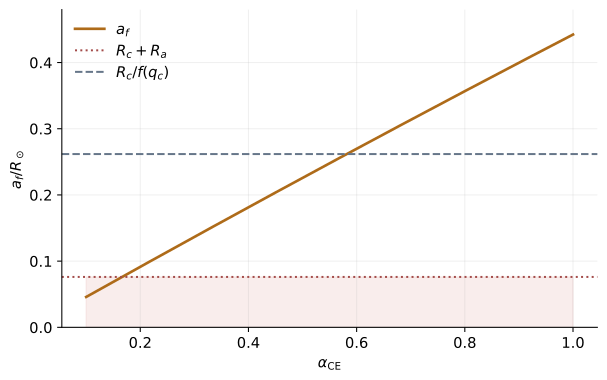
Eg=αCE(GMcMa2af−GMdMa2ai),af=[MdMcai+2EgαCEGMcMa]−1E_g=\alpha_{\rm CE}\left({GM_cM_a\over2a_f}-{GM_dM_a\over2a_i}\right),\qquad a_f=\left[{M_d\over M_ca_i}+{2E_g\over\alpha_{\rm CE}GM_cM_a}\right]^{-1}
The bracket is a positive orbital-energy release. Its unassigned fraction is not automatically radiation or ejecta kinetic energy.
Computed conditional final separation versus energy fraction, with separate direct-contact and core-Roche-fit boundaries
Own adaptation from the attributed four-solar-mass native profile. Red dotted: supplied-radius contact. Gray dashed: core Roche-fit boundary. Different line crossings represent different geometrical failures, not merger probabilities. Thoul & Chidester 2022 · CC BY 4.0

Direct Roche volumes give aisimeq89.24Rodota_isimeq89.24R_odot. For fractions one, one half, one quarter and one tenth, the conditional final separations are approximately 0.4423,;0.2258,;0.1141,;0.04593;Rodot0.4423,;0.2258,;0.1141,;0.04593;R_odot. These are endpoint solutions of the scalar equation, not samples along a gas evolution.

Assign the compact companion radius 2imes10−5Rodot2 imes10^{-5}R_odot. The one-tenth endpoint directly overlaps the two supplied surfaces. The half and quarter endpoints do not overlap, yet the supplied core is outside its own final Roche lobe. At fraction one both supplied radii fit. Keep these three cases distinct: none alone establishes inevitable survival or a computed merger.

The original giant’s cut radius is also not a thermally relaxed remnant radius. Solving pressure, shocks, gas transport and radiation requires a fluid model beyond this scalar equality. Read fluid calculations with those specific missing questions in mind. The near-machine-precision residual of this algebra cannot stand in for the accuracy of a fluid prediction.

Reading: Ivanova et al. (2013), Common envelope evolution; arXiv:1209.4302v2 · Thoul & Chidester (2022), MESA Summer School; Zenodo 7082536

Exercises and explanations

  1. If zeta∗−zetaL=0.2zeta_*-zeta_L=0.2, what does a small donor mass loss do to overfill?

    Read the explanation

    Since dlnMd<0dln M_d<0, the product is negative and overfill decreases. Writing the sign of the mass change before interpreting the exponent prevents a reversed conclusion.

  2. At alphamCE=0.25alpha_{ m CE}=0.25, the supplied surfaces do not touch. Why is this not yet an acceptable detached pair?

    Read the explanation

    Direct contact compares separation with the sum of supplied radii. Roche fit separately requires each radius to lie inside its own critical volume radius. The supplied core fails that second test. This excludes that detached endpoint under the stated radii, but does not calculate a merger probability.

  3. In this same equation, does Ego0+E_g o0^+ make the final separation approach the initial separation?

    Read the explanation

    No. Keeping the mass definitions fixed gives afo(Mc/Md)aia_f o(M_c/M_d)a_i. The full initial donor mass has become a core in the endpoint equation. Forgetting that change gives the wrong algebraic limit; the limit is not a full envelope-loss history either.

Try the prediction

Keep the threshold, then test the endpoint

  1. Choose the uncertain-threshold preset and expand the response/numerical details. Compare direct-volume and fitted derivatives. Why is the input left unclassified?
  2. Choose the compact-pair preset and set the energy fraction to one, one half, one quarter and one tenth. Distinguish Roche fit, lobe failure and direct overlap.
  3. Switch between the initial and conditional final views with their stated scales. Then change native donor profile. Identify the structural differences and the two distinct stars being compared.

Sources and calculation scope

  1. Eggleton (1983), Approximations to the radii of Roche lobes

    Both pages, equations 1–3 and the independently integrated column of Table 1. The fit describes volume radius, not the distance to the inner saddle. Original PDF remains upstream.

  2. Soberman, Phinney & van den Heuvel (1997), astro-ph/9703016v1

    Sections 2–3, angular-momentum loss channels, response exponents and AppendixA. Translate the paper’s donor/accretor names before using its mass-ratio convention.

  3. Ivanova et al. (2013), Common envelope evolution; arXiv:1209.4302v2

    Energy formalism, sources/sinks, timescales and core/remnant boundary discussions. The scalar endpoint does not predict the flow or an ejection morphology.

  4. Thoul & Chidester (2022), MESA Summer School; Zenodo 7082536

    CC BY 4.0. Exact lab3_4M_solutions/LOGS_cheb_case1/profile1.data from r22.05.1. Our gravity/core-cut aggregates and envelope figure are adaptations with attribution; not a new MESA run or total-age measurement.

  5. Jared Goldberg (2025), MESA School Leuven Friday model

    CC BY-SA 4.0; repository commit ade5bca00e5caae97ac0b6f880f1de7ccead1553, work_minimini3/ALPHA_TEST_LOGS/LOGS_mlt2mesh1time1/profile8.data. Derived structure aggregates retain these terms. This 15-solar-mass model is distinct from the frontier paper’s 12-solar-mass donor.

FeedbackSomething broken, confusing, or missing on this page?Tell us
What kind of feedback?

Sent with this page’s address, its Lab ID, the site language and your device type. Please leave out personal details. Feedback is kept for up to 12 months.Privacy policy