Add the angular momentum carried by both stars
Start with a circular point-mass binary. Temporarily neglect spin, angular momentum stored in a disc, and other external torques. The stars orbit at different distances from their common center of mass; the lighter one travels farther from it. Adding their orbital angular momenta gives a quantity that depends on both the mass distribution and separation.
These assumptions are physical choices. A disc or a stellar spin reservoir can exchange angular momentum with the orbit. If that exchange matters, orbital angular momentum cannot simply be held fixed. Declaring it negligible gives the conservative calculation below a clear, limited purpose.
Reading: Soberman, Phinney & van den Heuvel (1997), astro-ph/9703016v1
The conservative minimum lies at equal masses
Let be mass removed from the donor and entirely kept by the accretor. Then and . With both total mass and orbital angular momentum fixed, the response integrates directly.
For an initial donor and accretor, transferring makes both masses . Their product is largest there, so the separation is smallest.
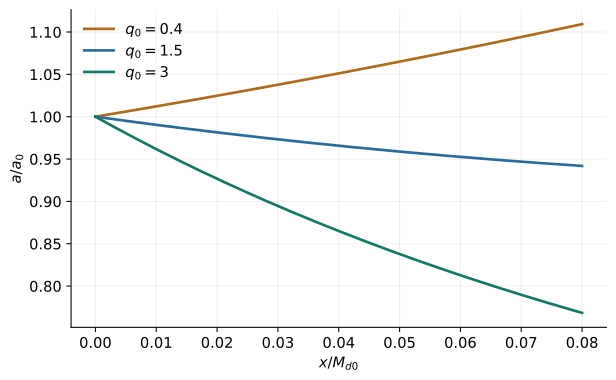
The figure uses removed mass as a fraction of the initial donor mass. Different initial mass ratios give different trends even though every curve keeps all matter in the system. When a lighter donor feeds a heavier accretor, their mass product decreases; preserving the same orbital angular momentum requires a wider orbit.
Reading: Soberman, Phinney & van den Heuvel (1997), astro-ph/9703016v1
Give escaped matter its own ledger entry
Suppose the accretor retains only a fraction . The donor loses , the accretor gains , and matter outside the binary gains . The third entry remains necessary even though that matter no longer belongs to the binary.
The same retained fraction can give different separations. Matter escaping with a larger specific angular momentum reduces the remaining orbital angular momentum more strongly. That effect competes with the response to redistributed masses. The orbit additionally depends on the specific angular momentum of that lost matter.
Reading: Soberman, Phinney & van den Heuvel (1997), astro-ph/9703016v1
The launch site supplies a different lever arm
Isotropic loss still carries the orbital motion of its source star. A donor wind differs from material that first reaches the accretor and is then isotropically re-emitted. Using each star’s distance from the center of mass gives the following factors in the same specific-angular-momentum convention.
For a fully unretained slow donor wind, . Substituting the donor lever arm into the response equation gives , hence the limit below.
MESA’s fixed jdot_ml_check example combines donor wind, accretor re-emission and ring loss. Its parameters must be read together with the specific-angular-momentum definitions. A ring radius or ring lever-arm factor is not automatically the gamma used here. Only the mathematical relationship is evaluated in this independent ODE comparison. Running the stellar structure solver and its full MESA evolution is a separate calculation.
Reading: Soberman, Phinney & van den Heuvel (1997), astro-ph/9703016v1 · MESA 25.12.1, jdot_ml_check; commit 4a68bfbce0f6930c3f861d0611e914f02569a899
Closing two ledgers does not conserve orbital energy
Even conservative transfer generally changes orbital energy while preserving total mass and orbital angular momentum. A real binary must account for accretion, stellar spin, heat and radiation in the larger energy problem. This chapter converts a declared mass/angular-momentum prescription into a circular orbit; it has not closed the gas energy equation.
Removed mass is also not an elapsed-time coordinate. A transfer rate needs an additional observation or a physical transfer prescription. The later Beta Lyrae tutorial supplies a historical period trend for a conditional rate calculation. It never infers that rate from how fast the trajectory animation plays.
Reading: Soberman, Phinney & van den Heuvel (1997), astro-ph/9703016v1 · Ivanova et al. (2013), Common envelope evolution; arXiv:1209.4302v2