Sandbox Physics
Binary mass transfer and common envelopes

AC29 · L1

Finding the passage between two stars

The masses and rotation determine where the narrow passage lies. Its distance from the donor center is not the radius of the donor’s Roche lobe. Setting up the forces and coordinates first makes the difference visible.

Turn with the circular binary

In an inertial frame the two stars keep moving. To ask whether gas can still surround the donor alone, turn with a circular binary instead. Its two point masses are now stationary on a horizontal axis, while a test parcel remains free to move. We have simplified the background, not frozen the gas.

Call the donor mass MdM_d, the accretor mass MaM_a, and their center-to-center separation aa. Let the horizontal axis point from donor to accretor, the second axis lie in the orbital plane, and the vertical axis point along the orbital angular momentum. These form a right-handed system. Put the origin at the center of mass; this is the geometrical midpoint only for equal masses.

q=MdMa,μ=MaMd+Ma=11+q,xd=−μ,xa=1−μq={M_d\over M_a},\quad\mu={M_a\over M_d+M_a}={1\over1+q},\quad x_d=-\mu,\quad x_a=1-\mu
Coordinates have been divided by the separation. The donor is on the left and q always means donor mass divided by accretor mass.

Choose units with G=Md+Ma=a=1G=M_d+M_a=a=1. The circular orbital angular frequency is then one too. Restoring dimensions uses Omega2=G(Md+Ma)/a3Omega^2=G(M_d+M_a)/a^3. These units describe the current frozen binary. Converting removed mass to elapsed transfer time additionally requires a rate.

Reading: Eggleton (1983), Approximations to the radii of Roche lobes

Follow the forces before choosing a potential sign

A parcel at rest in the rotating picture feels gravity from both masses and the centrifugal term of this coordinate system. Near a mass, the gravitational field varies rapidly. The centrifugal contribution depends on distance from the rotation axis. Moving vertically along that axis does not increase this distance, so there is no extra vertical centrifugal term.

U=1−μrd+μra+x2+y22\mathcal U={1-\mu\over r_d}+{\mu\over r_a}+{x^2+y^2\over2}
Here rd2=(x+mu)2+y2+z2r_d^2=(x+mu)^2+y^2+z^2 and ra2=(x−1+mu)2+y2+z2r_a^2=(x-1+mu)^2+y^2+z^2. Positive gravitational terms make this quantity the negative of the usual physical Roche potential.
x¨=∂xU+2y˙,y¨=∂yU−2x˙,z¨=∂zU\ddot x=\partial_x\mathcal U+2\dot y,\qquad\ddot y=\partial_y\mathcal U-2\dot x,\qquad\ddot z=\partial_z\mathcal U
A moving parcel also has Coriolis terms. They vanish when locating a stationary point but must remain in a trajectory integration.

A potential sign is a convention only if its force sign follows consistently. With the definition above, the gradient enters the acceleration directly. Using the negative physical effective potential requires its negative gradient instead. Changing just the potential sign while keeping the old force prescription describes another dynamical system.

Reading: Eggleton (1983), Approximations to the radii of Roche lobes

One direction does not determine a volume

0=x−(1−μ)(x+μ)∣x+μ∣3−μ(x−1+μ)∣x−1+μ∣30=x-{(1-\mu)(x+\mu)\over|x+\mu|^3}-{\mu(x-1+\mu)\over|x-1+\mu|^3}
Solve between −mu<x<1−mu-mu<x<1-mu for the inner stationary point. Equal masses place it at the origin. Zero force there is not a guarantee that gas can accumulate stably.

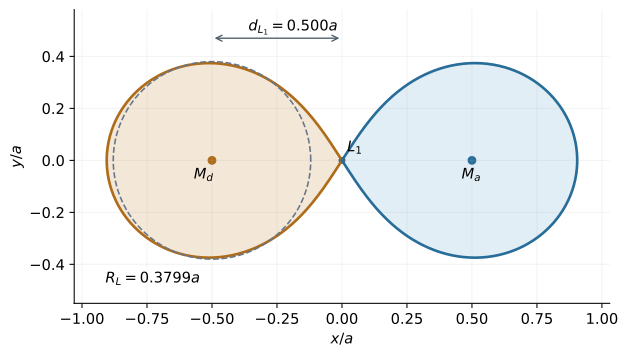
The critical equipotential through this point encloses a three-dimensional donor lobe with a pointed end. We can measure the distance from the donor center to that end. Or we can replace the entire volume by an equally large sphere and ask for the sphere’s radius. The latter defines the volume-equivalent Roche radius; the former measures only one direction.
VL=13∫r(n)3 dΩ,RL=(3VL4π)1/3V_L={1\over3}\int r(\boldsymbol n)^3\,d\Omega,\qquad R_L=\left({3V_L\over4\pi}\right)^{1/3}
Along each direction, find the first intersection with the donor-connected critical surface. Integrating these first radii excludes the region belonging to the other star.
Computed equal-mass Roche-lobe planar sections, the inner point and a dashed equal-volume sphere projection
Equal masses: the distance to the opening is 0.500a0.500a, while the three-dimensional volume radius is about 0.380a0.380a. Dashed: projection of the equal-volume sphere, not an equal-area planar section.

For equal masses, the opening is 0.500a0.500a from the donor center, whereas the three-dimensional volume radius is about 0.380a0.380a. The dashed circle is the projection of an equal-volume sphere. It does not claim that the circle and the lobe’s planar section have equal areas. The shape away from the orbital plane matters to the volume too.

Eggleton’s smooth formula approximates this volume radius. It does not return the distance to the opening, nor a physical surface radius valid in every direction. Many digits can evaluate the fit accurately. Its approximation error is assessed separately against a direct critical-volume calculation.

Reading: Eggleton (1983), Approximations to the radii of Roche lobes

Launch a massless probe through the opening

Hold the masses, separation and angular frequency fixed, then launch a probe near the passage. Changing its speed or transverse starting position changes the curved route. Coriolis acceleration redirects the velocity without directly doing work. The corresponding Jacobi constant provides a useful integration check in the fixed potential.

CJ=2U−(x˙2+y˙2+z˙2)C_J=2\mathcal U-(\dot x^2+\dot y^2+\dot z^2)
This constant belongs to the declared circular restricted problem. Once masses, orbit and gas interactions evolve, the energy exchange of the full system needs a new treatment.

Stopping a route at the supplied companion surface is a geometrical impact condition; it does not calculate the resulting shock or heat. A route that misses the star does not yet establish a stable disc. Pressure, collisions, gas self-gravity and radiation are absent from the massless probe. Its orbital flight clock therefore remains separate from the prescribed amount removed from a donor.

Reading: Soberman, Phinney & van den Heuvel (1997), astro-ph/9703016v1

Exercises and explanations

  1. Why does exact force cancellation at the equal-mass inner point not establish stability?

    Read the explanation

    Cancellation identifies an equilibrium. Stability asks what small displacements and velocities do, including the Coriolis coupling. The full linearized problem at the inner point has a growing solution. A stationary point is therefore not automatically a stable resting place.

  2. What goes wrong if we use RL=0.5aR_L=0.5a for equal masses?

    Read the explanation

    That substitutes the one-direction distance to the opening for a three-dimensional volume radius. The equal-volume sphere has radius about 0.380a0.380a. The critical surface lies at different distances in other directions.

  3. A program mistakenly adds z2/2z^2/2 to the potential and integrates the matching force. Its Jacobi constant stays accurate. Does this validate its binary geometry?

    Read the explanation

    No. A wrong potential and a consistently wrong force can conserve their own invariant. Rotation about the vertical axis supplies no vertical centrifugal force. Check coordinates and the physical forces before using conservation to assess the numerical method.

Try the prediction

Compare the pointed end with the whole volume

  1. Set removed fraction to zero, move initial mass ratio near one, and set initial filling to one. With nearly equal point masses, the passage should approach their midpoint.
  2. Inspect the donor’s pointed end and stream start. Export the record and compare the currentRoche volume radius with the donor-center distance to l1, then compare with the analytic equal-mass case.
  3. Drag the green launch arrow to alter speed or transverse position. Identify which changes follow from the same fixed potential and which gas processes remain outside this calculation.

Sources and calculation scope

  1. Eggleton (1983), Approximations to the radii of Roche lobes

    Both pages, equations 1–3 and the independently integrated column of Table 1. The fit describes volume radius, not the distance to the inner saddle. Original PDF remains upstream.

  2. Soberman, Phinney & van den Heuvel (1997), astro-ph/9703016v1

    Sections 2–3, angular-momentum loss channels, response exponents and AppendixA. Translate the paper’s donor/accretor names before using its mass-ratio convention.

FeedbackSomething broken, confusing, or missing on this page?Tell us
What kind of feedback?

Sent with this page’s address, its Lab ID, the site language and your device type. Please leave out personal details. Feedback is kept for up to 12 months.Privacy policy