Expanding ejecta carry a velocity label
In homologous expansion, each unshocked ejecta parcel moves freely, so its radius is its constant velocity times age: . Consider a spherical envelope whose density falls with the inverse th power of that velocity. Expansion dilutes a fixed velocity interval as . Writing the resulting density in radius coordinates gives the first expression below.
The constant fixes the envelope normalization; it is one named dimensional constant, not an extra numerical power to be adjusted independently. Outside lies stationary ambient gas of uniform density . We assume cold upstream material and an adiabatic, nonradiative monatomic gas.
At a shock, pressure is of order upstream density times relative speed squared. If all three surfaces grow as , both characteristic relative speeds scale as . Their density ratio must therefore stay fixed for the two postshock pressures to maintain a self-similar match. The ejecta density at a surface scales as ; setting its exponent to zero gives .
Pressure and velocity meet at the contact
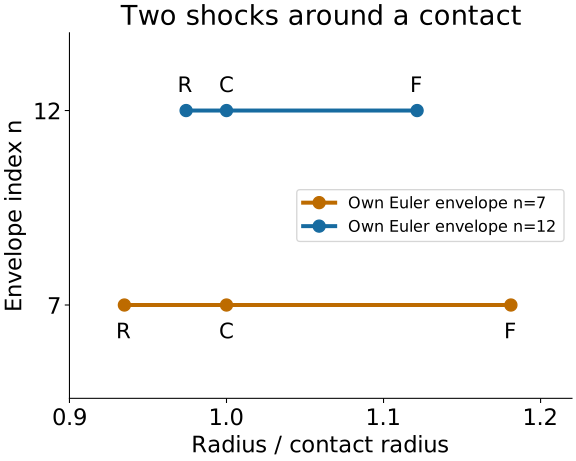
Apply the previous chapter’s jump conditions separately at the forward shock and at the reverse shock. Integrate each shell toward the contact. The two sides must have a common contact radius, a common pressure and the velocity needed to move that contact. Their densities can differ; material does not freely cross this separating surface.
Our independent spherical Euler integration gives and for . The same calculation for gives a different pair of shell thicknesses. The offline producer checks the rounded original Table 1 intervals and independently integrates the swept masses and energy.
Near the ideal contact, a dimensionless profile can become singular. The numerical integration stops a declared positive distance before that endpoint and compares two tolerances and endpoint offsets. No interpolation carries a density or temperature straight across the contact.
The interactive scene uses the n7 radii, immediate shock boundary values and known unshocked densities. The independent reader integrates the shocked shells for its scientific checks; the scene does not invent a full interior density map from the shell boundaries.
Reading: Chevalier (1982), Self-similar solutions for the interaction of stellar ejecta with an external medium, ApJ258,790–797 · Sandbox Physics independent supernova-remnant Python science reader
A finite star cannot have an infinite power-law core
The envelope law describes the outer ejecta. Extending it down to zero velocity would give an unphysical central mass. For a dimensional example, join it continuously to a flat-density inner core at velocity . Integrate mass and kinetic energy over velocity shells, using and . The common time factors cancel.
If density is in the core and outside, the core and envelope mass terms are proportional to and . The kinetic-energy terms contain and . Both are finite for , and their ratio yields the transition velocity below.
The envelope solution remains applicable only while . In the fixed-age Lab, this condition is checked over the short particle window as well as at its beginning. Increasing density eventually invalidates that condition; a different gas solution is then required and this input is refused.
Reading: Chevalier (1982), Self-similar solutions for the interaction of stellar ejecta with an external medium, ApJ258,790–797 · Sandbox Physics independent supernova-remnant Python science reader
Make a prediction at one fixed age
For , radius scales as when energy, ejecta mass and age stay fixed. Increase ambient density by a factor of 128. Because 128 is two to the seventh power, every surface radius halves. Its instantaneous speed also halves, since at that same age.
Doubling age is a different experiment: the envelope radius grows by , whereas its speed changes by . The App density presets keep the physical age at about 148.578 years; they do not move to another age to keep the reverse shock at a preferred location.
The factor 128 exercise illustrates the scaling algebra. It is not a claim that both environments lie inside the interactive control domain or remain in the envelope phase. Before applying any dimensional example, check the reverse-shock core condition.
Reading: Sandbox Physics independent supernova-remnant Python science reader
A point blast has a different conserved starting quantity
In the separate Sedov–Taylor problem, a point deposits fixed energy into uniform ambient density , with negligible ejecta mass. No ejecta core or reverse shock is supplied. Dimensions alone require the radius to scale as . A dimensionless coefficient remains.
To determine it, integrate the spherical Euler profile behind the strong forward shock, then integrate its kinetic and internal energy over volume. Requiring that integral to equal the prescribed energy fixes the coefficient. This is more information than dimensional analysis provides.
The independent producer uses three shrinking central cuts and reports the unresolved central thermal contribution separately. It obtains and . Swept mass and a local energy-flux first integral provide additional checks. The public reader reruns the three-cut integrals and outputs these values.
The ejecta-envelope and point-blast laws have different initial assumptions. Their exponents can be compared, but placing one curve after the other does not solve the transition. A consistent transition through the ejecta core requires another dynamical calculation.
Reading: Leahy & Williams (2017), A Python Calculator for Supernova Remnant Evolution, arXiv1701.05942v2 · Sandbox Physics independent supernova-remnant Python science reader