Choose a gas sheet and its coordinates
Take one small patch of a gas disk. Its area is and its mass is . Define its gas column as mass divided by area, so column has units of kilograms per square metre. A large column gives the wind more mass to accelerate behind the same exposed area.
Use the galaxy rest frame. The axis points along the disk normal and the incoming wind; is cylindrical distance from the centre in the disk plane. The incoming speed is positive, while the patch has its own normal velocity. With a fixed area, the force from relative normal motion follows the signed momentum flux.
Writing the relative-speed factor with an absolute value matters. When a patch moves faster than the incident flow, the direction of the drag reverses. Replacing it everywhere with the incident pressure is a useful scale estimate only when the patch speed is small compared with the wind.
The path offset is : closest-approach distance divided by the atmosphere core scale . The five computed values are 0, 0.37, 1.5, 2.72 and 4. The galaxy speed stays fixed; changing the offset selects a different complete pressure history.
Reading: Original fixed-slice and static-restoring-force materials
Why vertical gravity has a maximum
The force toward a smooth midplane is zero exactly at the plane, rises above it and eventually weakens far from the galaxy. A gentle steady push can shift a gas sheet to a new height where upward pressure balances downward gravity. A stronger push can exceed the largest available restoring acceleration at that fixed radius.
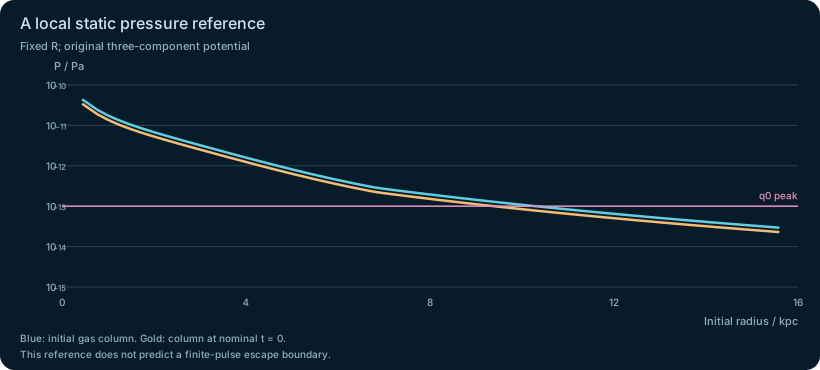
The local static reference multiplies that maximum acceleration by the gas column. It is closely related to the Gunn–Gott pressure comparison. Its meaning is a force balance for a slowly changing configuration. It does not by itself describe how far a patch moves during a short pulse.
Our independent reference uses the declared three-component potential and searches positive heights at each initial radius. It shows one curve with the initial column and another after the specified consumption up to nominal closest approach. Those columns differ because gas mass is gradually converted into stars while the sheet area stays fixed.

Reading: Köppen, Jáchym, Taylor & Palouš, Ram Pressure Stripping Made Easy, arXiv:1806.05887v1 (2018) · Original fixed-slice and static-restoring-force materials
A short gust delivers an impulse
If the pulse is much shorter than the time the gas needs to move up and down in the potential, the gas barely changes position while the strongest push occurs. Add up pressure multiplied by each tiny time interval. The result is impulse per unit area: pressure integrated over time.
Divide that impulse by the column and you obtain a velocity change in the simplest short-pulse approximation. A pulse of twice the height and half the duration has the same impulse. That statement assumes the column stays nearly constant and ignores gravity and the changing relative speed during the short push.
For a numerical scale, take a pressure of one ten-trillionth pascal acting for 100 million years on a column of 0.002 kilograms per square metre. With the declared time-unit convention, the simple impulse estimate gives about 158 kilometres per second. Stretching the same pressure across a much longer interval eventually invalidates the short-pulse approximation because gravity and motion have time to respond. Use this estimate only when the vertical response time is much longer than the stated pulse duration.
Reading: Köppen, Jáchym, Taylor & Palouš, Ram Pressure Stripping Made Easy, arXiv:1806.05887v1 (2018) · Original fixed-slice and static-restoring-force materials
Let the vertical motion set the comparison
Near the midplane, a smooth potential often looks approximately like a spring: restoring acceleration grows roughly in proportion to height. The gas then has a natural vertical oscillation period. A pulse lasting much longer can be followed almost statically; a much shorter pulse resembles a kick.
Between these limits the gas moves while the pressure changes. Its velocity changes the drag, its column evolves, and gravitational work matters throughout the encounter. Integrating the actual equation of motion is how to follow that middle region.
The pressure curves in the reference figure therefore help form a prediction, then the saved trajectory tests its consequence. A local static threshold, a maximum tail height and the eventual bound mass describe related parts of the same event. They are useful together when their definitions remain explicit.
Reading: Köppen, Jáchym, Taylor & Palouš, Ram Pressure Stripping Made Easy, arXiv:1806.05887v1 (2018) · Original fixed-slice and static-restoring-force materials