Keep reading
You are hereFit the Polarization of PSR J0908−4913
Radio Beams from a Spinning Neutron Star · Reading path
The two pulses of J0908−4913 carry enough angle information to check a model fitted to just one of them. Use the 2019 October 19 calibrated profile from the MeerKAT archive to repeat that check.
The download contains one versioned PSRFITS member from the Thousand-Pulsar-Array archive. Its SUBINT extension has four Stokes values in eight frequency channels and 1,024 phase bins. Multiply each stored integer by its scale and add its offset. Read the period from the history bin width, which gives 0.1067673 seconds for this fold.
The archive lists a dispersion measure of 180.585 and a rotation measure of 10 in the processing history. The final flags show the exported fold at zero applied correction. Without alignment, summing the channels spreads the pulses over much of the rotation.
The delay constant is 4.148808 milliseconds when frequencies are expressed in gigahertz and dispersion measure in the usual parsec per cubic centimeter. Advance each channel by its differential delay to 1,283.582 MHz. The periodic transform handles shifts of several complete turns. Subtract a measured off-pulse baseline and undo the differential Faraday rotation before using the supplied channel weights.
The corrected profile has intensity maxima around bins 8 and 513. The panel below marks angle measurements only where the linear polarized amplitude exceeds eight off-pulse noise estimates. Intensities use the same normalization for both curves.
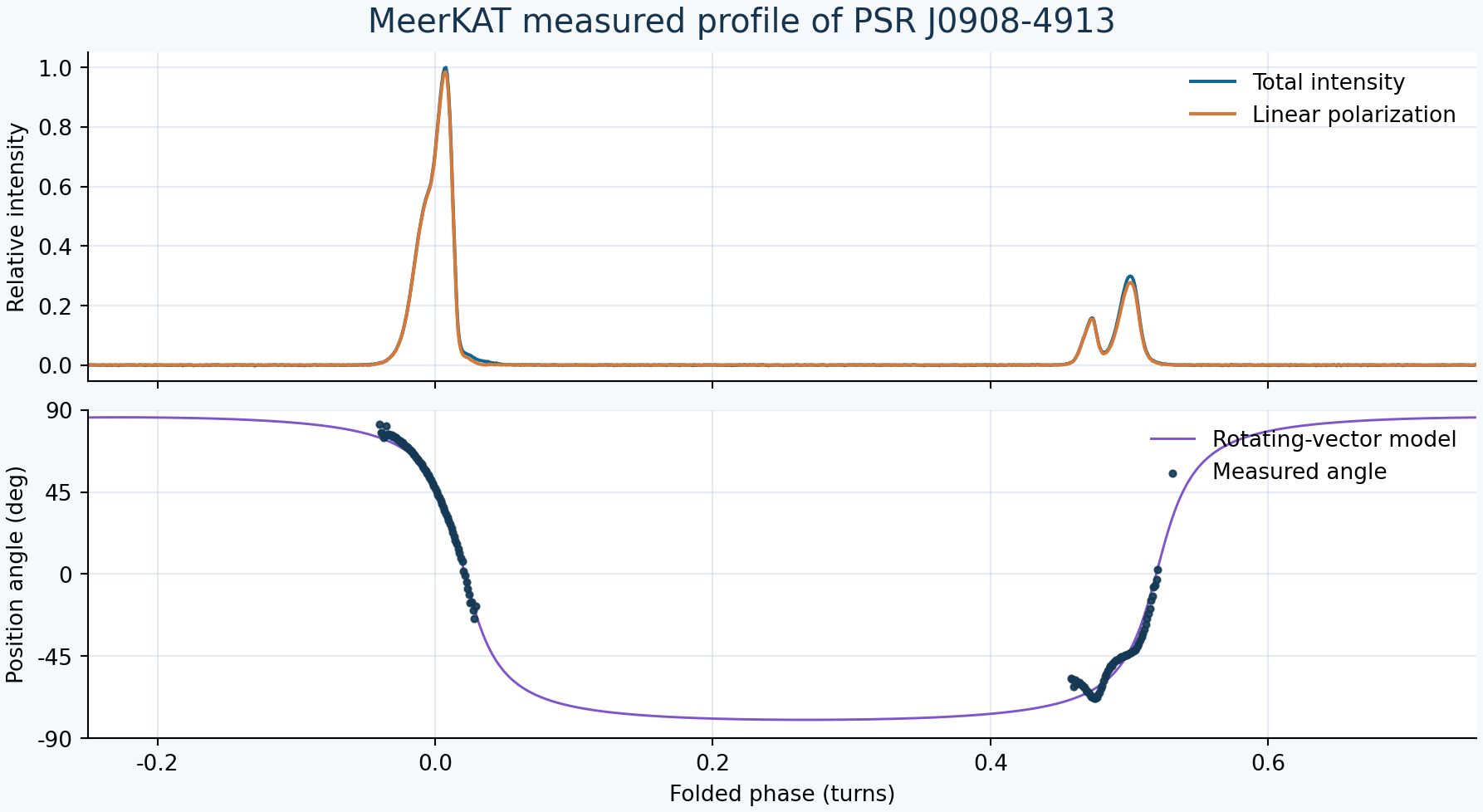
Fit the position angle with an axial residual and a 1.5-degree error floor. The two-window run uses 137 bins. One orientation convention gives magnetic inclination 97.06 degrees and a sightline 90.12 degrees from the spin axis. Reflecting both directions and reversing the polarization convention gives the same curve.
Use the main pulse alone and the median absolute residual there is 0.61 degrees. The same fit misses the interpulse by 62.6 degrees. The two-window fit gives median residuals of 2.28 and 4.86 degrees. The remaining angle structure is larger than the off-pulse noise estimate.
python reduce_profile.py "J0908-4913_2019-10-19-05:56:16_zap.8chTS.fluxcal.ar" --out observed.json
python fit_orientation.py observed.json --out fits.jsonUse the intensity-weighted center of each selected window as its phase reference. The observed lag then corresponds to about 162 kilometers at the main pulse and 227 at the interpulse. These are conditional estimates for this definition of center, this fit and this first-order model.
The replay also chooses a new emission radius and shifts the free reference phase to compensate. The position-angle prediction stays identical on the sampled grid. Keep the single-window failure and both conditional heights with the fit so the next reader sees what the data actually determine.
MeerKAT PSRFITS and scripts · 115,197 B
SHA-256 3f83c2a623ac313f8cb68089bdf03d21a60b3f06ab39e8a30eb4df2528575904
Sections 3 and 4 fit the position-angle swing and discuss the radio beam geometry of PSR J0908−4913.
The low-altitude, first-order calculation relates the angle swing’s delay to the emission radius.
Version 1 archive, calibrated folded eight-channel IQUV profile of PSR J0908−4913 from 2019-10-19.
The folded SUBINT table documents the storage order, scale factors and channel weights.
You are hereFit the Polarization of PSR J0908−4913
Radio Beams from a Spinning Neutron Star · Reading path