An effective collecting area
Imagine a narrow beam carrying . An object with absorption cross section receives of heat from that beam. A cross section is an effective collecting area; it need not equal the geometric area at every wavelength.
For many grains it is convenient to divide cross section by dust mass. The absorption opacity then has units . The kilogram here means dust, not hydrogen and not gas plus helium. Changing that convention would change the inferred mass. The Lab chooses a teaching opacity per dust mass; the Astrodust tables use their own explicitly stated per-hydrogen normalizations.
A star supplies a spectrum, so we replace total beam flux by in . Multiplying by and integrating over frequency gives a heating rate per dust mass. Absorption belongs in this expression. An extinction opacity would incorrectly heat the grain with light that was merely scattered.
Reading: Hensley & Draine, arXiv:2208.12365v1 (2022) · Dust absorption, heat and polarization: standalone science
Why cooling has an angular factor
The Planck function specifies thermal radiance: power per projected area, per frequency, per solid angle. It has units . For an isotropic material, thermal emission by a small dust mass into one direction is per solid angle. Integrating all directions supplies .
This statement does not mean that a black surface emits four times its Stefan–Boltzmann flux. A surface and an absorption cross section use different areas. For a spherical gray grain, the beam intercepts its projected disk while emission comes from its entire surface. The two descriptions give the same result when their geometry is kept consistent.
Set outgoing power per mass equal to absorbed power per mass. The cooling integral increases with temperature, so a positive heating rate has a unique root for the material used here. Solving that one-dimensional equation is easier than interpreting a complicated infrared map; the difficulty lies in calculating the correct heating and material response.
Reading: Dust absorption, heat and polarization: standalone science
Worked example: a gray spherical grain
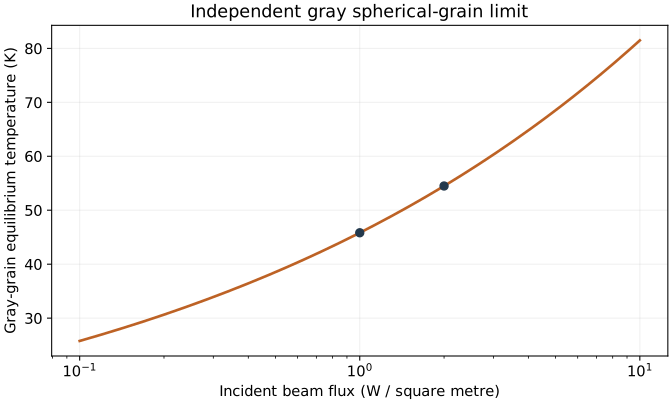
Let a spherical grain absorb and emit perfectly at every relevant wavelength. A parallel beam of total flux supplies , where is the grain radius. Its surface radiates . Cancel the same geometric factor before taking the fourth root.
For , the result is . Doubling the flux gives , a factor , not twice the temperature. The grain gets better at losing energy as it warms.
The radius cancels only because this example is gray and has the same absorption and emission efficiency at all wavelengths. Real small grains generally have size-dependent efficiencies. The Lab’s opacity is also not gray: it turns over near a micrometre and becomes approximately quadratic in frequency at long wavelengths. This calculation checks the geometry and units; it does not replace that material model.
Reading: Dust absorption, heat and polarization: standalone science
A different material changes the temperature scaling
Suppose, only over the frequencies carrying most of the cooling, . Substitute into the Planck integral. The frequency powers and differential together give cooling proportional to . Thus gives a sixth-power cooling law.
If the shape of the illuminating spectrum stays fixed and only its strength changes, heating is proportional to that strength. In the long-wavelength approximation, temperature then changes as its power. This is a useful local expectation. It is not an exact law for moving a cloud whose internal spectrum also reddens.
In the producer, each cell receives the spectrum that actually survived its upstream column. The program integrates that changed spectrum to obtain the local heating. A single scaled template misses this change of spectral shape, so shielded cells require the full local spectrum.
Reading: Hensley & Draine, arXiv:2208.12365v1 (2022) · Dust absorption, heat and polarization: standalone science
Frequency and wavelength must agree
A spectrum per hertz is not numerically the same as a spectrum per metre. The same finite power must occupy corresponding bins, so at . The Planck functions obey the same Jacobian. The opacity is a cross section per mass evaluated at the corresponding frequency; it does not acquire another spectral-density Jacobian.
A useful independent check integrates the same heating once in frequency and once in wavelength. Agreement tests both the coordinate conversion and the integration limits. Merely relabeling a frequency axis as wavelength would fail this test.
A finite spectral grid also misses its two tails. The scientific replay bounds the omitted source and cooling powers separately. A tiny root residual on a truncated integral would otherwise certify only that truncated equation, even if physically important heating had been left out.
Reading: Dust absorption, heat and polarization: standalone science
A solved root is not the final physical check
An optically thick infrared cloud can absorb its own thermal emission. Then the direct starlight balance alone is incomplete: neighboring grains heat one another. The present producer accepts only cases whose bolometric upper bound on neglected infrared absorption is below one part in a thousand. It also bounds neglected heating by the cosmic microwave background and accepts only its stated warm range.
These checks answer different questions. Deposited power matching emitted power tests the local cooling balance. A cloud-mass check tests geometric quadrature. Image refinement tests the representation of the same cells through a finite point-spread function. None can stand in for the others.
Try increasing dust mass until the infrared-escape condition fails. The last valid calculated cloud remains visible with a refusal notice. Treat that as information about the approximation: the requested case needs more radiative transfer, even if a numerical temperature root could still be found.
Reading: Dust absorption, heat and polarization: standalone science