One loud spike can drive up a matched-filter score. A chirp has a further obligation. The parts of its score from different frequency bands should agree with the pattern predicted by that template.
Start with sections IV and VI of Bruce Allen’s published 2005 analysis. They split the template’s noise-weighted power among bands. If the waveform matches, the expected contribution from a band follows its share of the template power. A transient with much of its power near one frequency can give a high total even when most bands fall short. The paper also treats mismatch: a genuine waveform that fits imperfectly can increase the same statistic. Allen, arXiv:gr-qc/0405045v2
With eight bands, the demonstration estimates a complex contribution zi per band. Write their sum as z and the template power fraction for each band as pi. Small differences from one-eighth come from finite frequency bins. The diagnostic used here is
χr2=141i=1∑8pi∣zi−piz∣2.
Fourteen is the number of independent differences after the complex total has been fixed. A perfectly matching noiseless example has zero discrepancy. In ideal Gaussian noise fluctuations remain.
Compare two synthetic examples
Use the same noise curve, template and lag window as the Hanford controls. The first noisy injected chirp has a matched score of 7.18 with reduced discrepancy 1.67. The specified sine-Gaussian glitch gives a similar score of 7.32, with discrepancy 10.45. These are two particular checked trials with known inputs. Their difference is a way to read the paper’s statistic with real numbers. LIGO–Virgo detector noise guide, §5
Keep the trial count in view
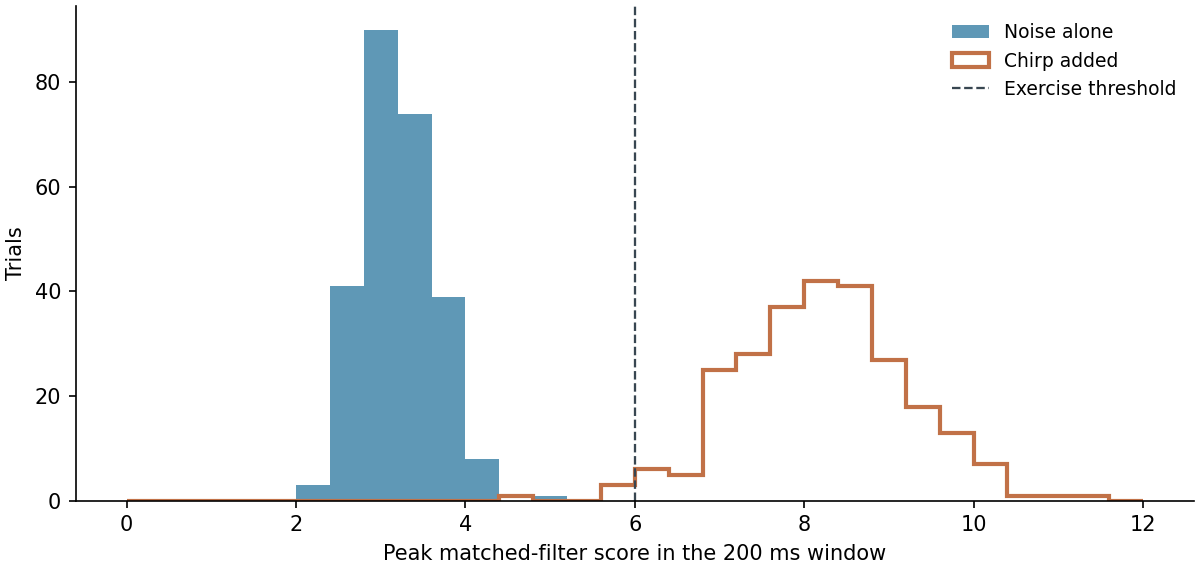
At one chosen arrival in ideal colored noise, the mean squared quadrature score is two. Searching across arrival times gives noise more chances. In our 256 search windows with one fixed template, one noise trial reached five and none reached six. When an injected chirp had optimal score eight, the procedure recovered 252 of 256 within ten milliseconds at a score of at least six.
These counts describe this simulated exercise. A false-alarm rate for an observing run needs real instruments, the actual template bank, the coincidence selection, and a much larger measured background. You can rerun the toy experiment with the saved seed or compare the fitted residue at an intentionally wrong mass.