Static quadrupole response
The Love number comes from the layered fluid. The fifth power makes compactness matter even when the Love numbers are close.
How much mass can a neutron star support? A neutron star can gain mass up to the point where pressure no longer supports a stable equilibrium. The limit depends on how fast the pressure rises when matter is compressed. A typical stellar radius and a tidal measurement probe this pressure at different densities from the maximum mass.
Change the pressure of dense matter and watch the stellar radius, mass limit and tidal response move together. Compare each sequence with public NICER and GW170817 samples.
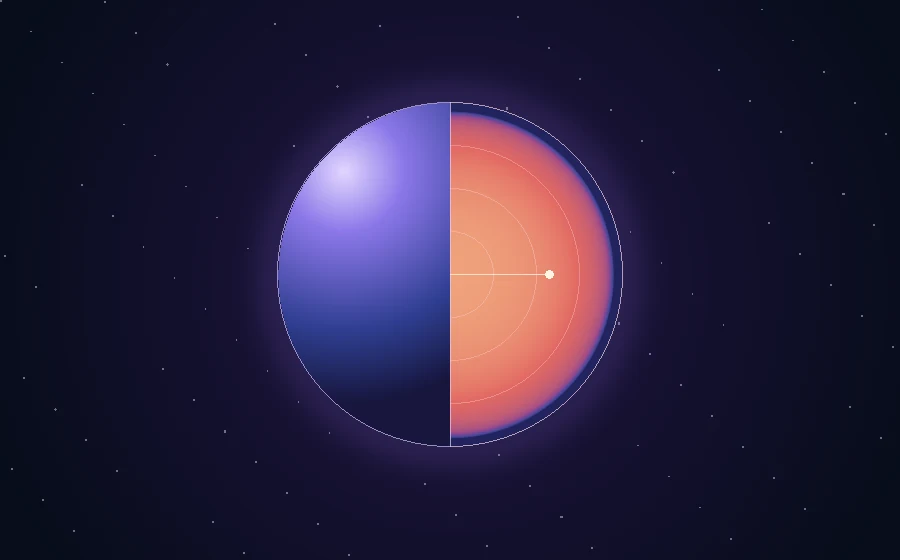
Saved default cutaway. The numeric controls still recalculate.
The selected star lies on the rising mass branch.
Shell probeWarm colors show denser matter.
Log density , log pressure
Drag the pressure anchor at the first core join.
Radius (km), mass (solar masses)
Teal bins count 2019 NICER draws. The dashed branch follows the first mass peak.
Mass ratio, dimensionless binary tide
Shared EOS, source chirp mass . Teal bins count low-spin GWTC-1 draws.
BackgroundThe center of a neutron star has the highest pressure. Each shell helps support the matter outside it. Gravity grows stronger when pressure and energy density rise.
Why it mattersMeasurements look at the outside of the star. Its radius and the tide raised by a companion let us test how matter behaves inside.
The Love number comes from the layered fluid. The fifth power makes compactness matter even when the Love numbers are close.
Typical misconceptionA large radius tells me the maximum mass exactly.
Better mental modelA star of ordinary mass never reaches the deepest part of a heavier star. Change the deep-core slope and see which part of the sequence moves.
Start with SLy, then select H4. Read the radius and tidal deformability.
What to observe: The two presets start close to the same mass. H4 has the larger radius and almost three times the tidal deformability.Increase the central density in H4 and follow the white dot into the dashed curve.
What to observe: Past the first mass peak, further compression lowers the equilibrium mass. The dashed sequence is radially unstable.You are hereNeutron Star Structure and Tidal Deformability
Inside a neutron star · Reading path
Articles on this path that use this experiment, followed by the other experiments they suggest.