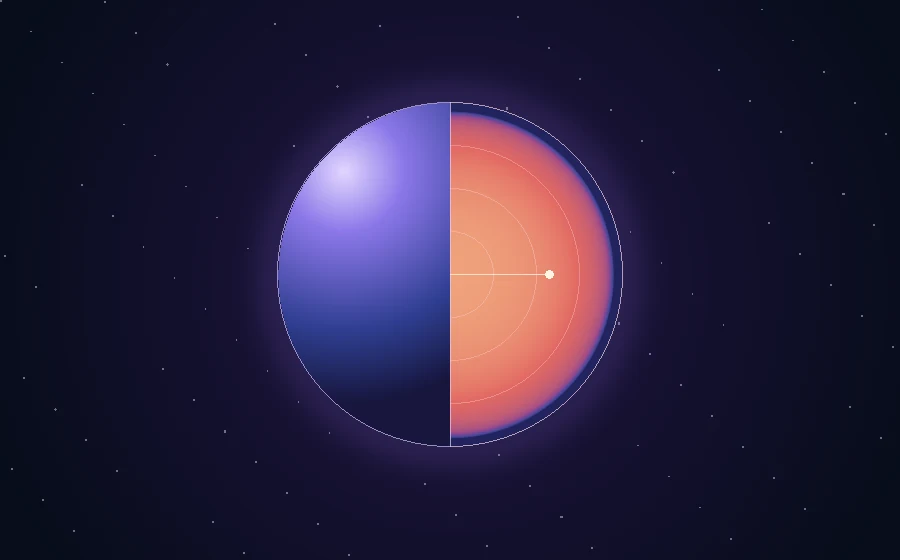
A cold neutron star can carry more mass if its matter pushes back hard when squeezed. At some mass even that pressure cannot hold a stable star together. Where the limit falls depends on how the pressure grows in the buried core.
A 1.4-solar-mass star in the SLy fit. The warmer layers are denser.
Pressure has to rise toward the center
Picture a thin shell buried under the surface. The fluid below it pushes upward harder than the fluid above pushes down. That difference balances the shell’s weight. Deeper shells have more matter above them, so the pressure builds toward the center.
At nuclear densities the particles are packed close enough to feel strong forces from their neighbors. The equation of state describes how much pressure that crowded matter produces at each density. We can make some of the ingredients in a laboratory. A neutron star holds a much larger piece of cold matter under pressure for a much longer time.
Adding mass does two things at once. It squeezes the existing matter harder, and it deepens the gravity in which the pressure has to work. In general relativity, pressure itself contributes to that gravity. When we compute a family of equilibria at steadily higher central density, the mass can stop rising and begin to fall. At that first peak, the star loses its ability to spring back from a small radial squeeze.
Take three stars with 1.4 times the Sun’s mass, built from different fits to dense matter. In our calculation the APR4 example has a radius of 11.32 kilometers. H4 has a radius of 13.95 kilometers. SLy falls between them. The difference comes from the pressure profile through the outer and middle core.
The larger star is easier for a companion to deform. Its tide changes the rate at which a tight binary finishes its orbit, a small part of the gravitational-wave signal. The number we use to describe that tide is almost three times as large for H4 as for SLy at this mass, even though their radii differ by about two kilometers.
NICER watches the X-rays from hot regions on a spinning neutron star. Gravity bends the light, so a region can stay visible after it has rotated partway behind the limb. The shape of the pulses carries information about compactness. Riley’s 2019 analysis of PSR J0030+0451 allowed a range of masses and radii that tend to move together.
GW170817 supplied a different measurement in August 2017. During the last part of its inspiral, each star pulled a tide out of the other. The measured wave phase depends on the masses and the combined tidal response. One radius and one inspiral can narrow the possibilities for pressure. To learn what happens at the very highest densities, we also need to know how heavy a star can survive.
Switch from SLy to H4. Watch the cutaway get wider and compare the tidal readout. Then increase the H4 central density and follow the mass curve to its peak.