Keep reading
You are hereWhy galaxies merge even though their stars rarely meet
Galaxies in close encounters · Reading path
Two galaxies can come together because gravity shifts energy out of their mutual orbit. Stars are far apart on the scale of their own diameters, so very few touch. Each can still feel the changing pull of the entire passing galaxy.
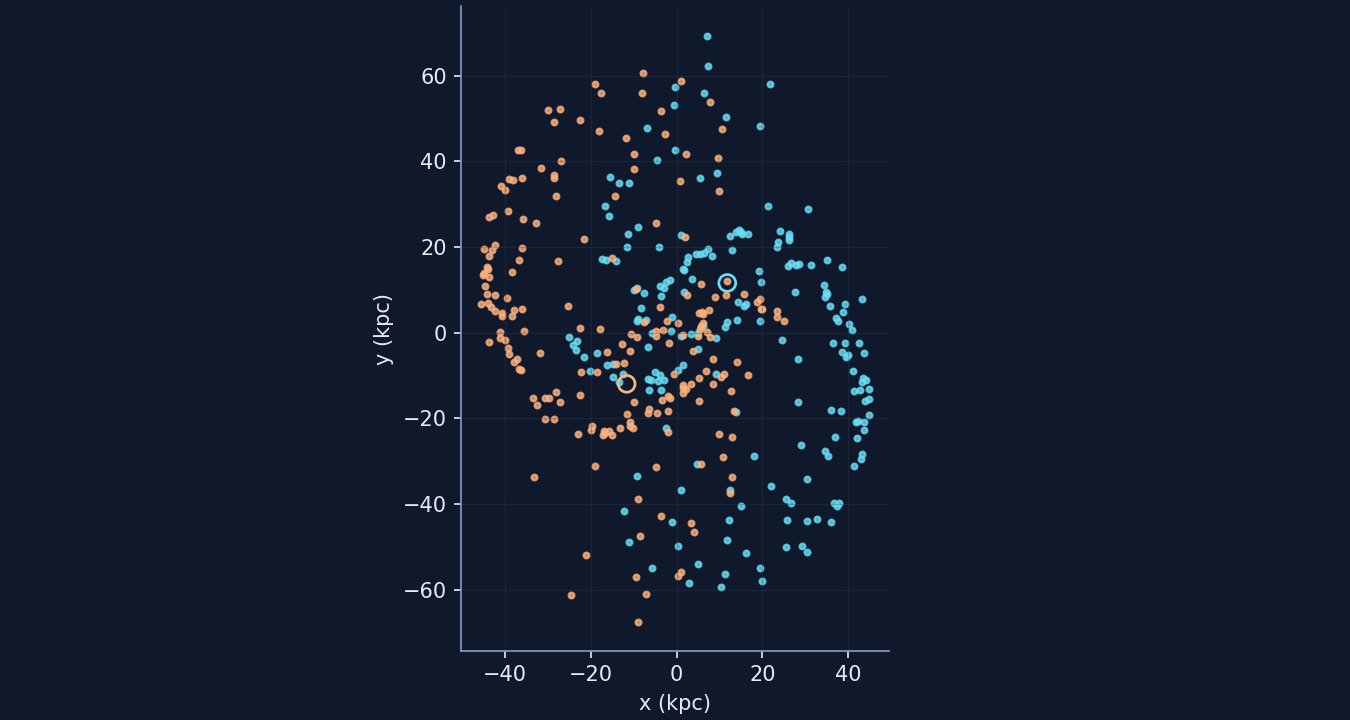
Take a star on the side of a disk nearest the other galaxy. It gets pulled harder than the center of its own galaxy. A star on the far side is pulled less. Watch from the center as the pair sweeps by: both stars drift away from you, in different directions.
The response lasts after the galaxies part. Many stars that started near one another leave on similar paths, so a broad piece of disk can turn into a thin, curved tail. A bridge can run toward the passing galaxy at the same time.
Each galaxy includes a halo, a broad cloud of gravitating matter around its bright disk. As the two haloes overlap, their particles arrange into new patterns under the passing pull. Some of the energy of the motion between the galaxies ends up in motion and deformation within them.
If the centers keep too little orbital energy to escape, they can turn back and pass again. In a fast flyby there is enough energy for the centers to separate even when the passage leaves long tails. The curve of their separation tells those stories apart.
Chandrasekhar, Dynamical Friction I (1943) · Galaxy encounter direct-sum runs and archived numerical checks
Switch from Two long tails to Fast flyby. Take both runs through their closest pass and watch what the two bright centers do once the tails start to grow.
Sections II–IV compare passages of disks represented by noninteracting tracers. Use the restricted method and the encounter drawings.
Section III derives drag from weak gravitational deflections. Its field-star distribution is a local approximation in our application.
Matched isolated controls, two timesteps, two particle counts and fixed local-drag comparisons for the released trajectories.
You are hereWhy galaxies merge even though their stars rarely meet
Galaxies in close encounters · Reading path